Statistics

Last Updated
Jan 2, 2026
Living with chronic pain is an experience that statistics alone can't fully capture. It's a persistent, unwelcome companion that reshapes daily life. As someone who has navigated my own journey with persistent health challenges, I understand that behind the staggering numbers are individual stories of resilience. In 2023, health reports indicated that more than 60 million adults in the United States live with chronic pain. This isn't just a number—it represents a significant public health issue affecting millions of families, careers, and communities.
A Story Told in Numbers
While each person's experience with pain is unique, the data provides a powerful sense of validation. It confirms that you are not isolated in this struggle. Understanding the sheer scale of chronic pain is the first step toward building greater empathy and advocating for more effective solutions.
This visualization clearly illustrates the sharp increase in chronic pain cases, comparing the landscape in 2019 to just four years later.
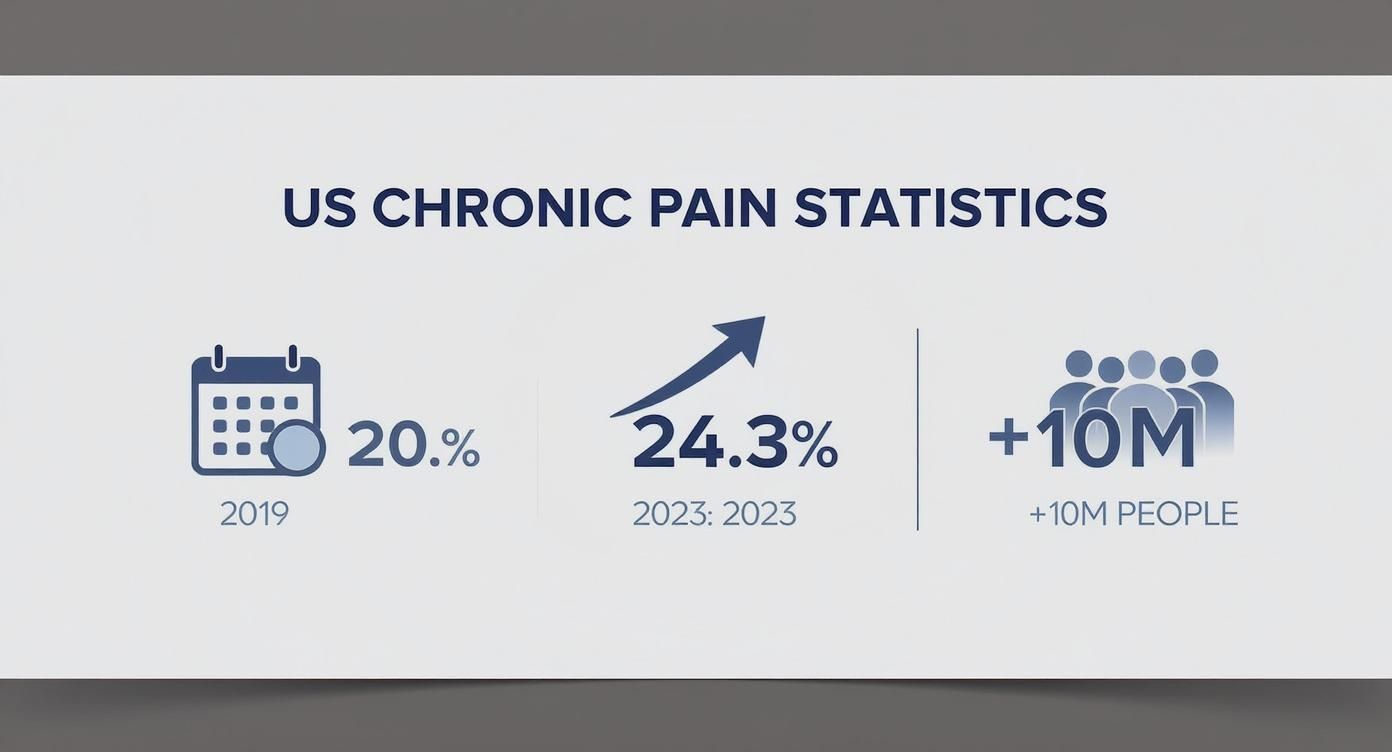
This trend, particularly in the post-pandemic era, signals a critical shift in the nation's health that requires our full attention.
For a concise overview, here is a summary of the most critical statistics based on recent health information.
Key Chronic Pain Statistics at a Glance
Statistic Type | Affected Population | Key Figure |
|---|---|---|
Overall Prevalence (2023) | U.S. Adults | 24.3% |
Total U.S. Population | U.S. Adults | Over 60 million people |
Recent Increase | 2019 vs. 2023 | From 20.4% to 24.3% |
Growth in Population | Absolute Increase | An additional 10 million people |
These figures paint a clear picture: chronic pain is not only widespread but its prevalence is growing at an alarming rate.
A Growing National Concern
The latest research points to a significant post-pandemic surge in chronic pain prevalence across the United States. In 2019, health data showed that approximately 20.4% of American adults reported dealing with chronic pain.
By 2023, that number had climbed to 24.3%. This translates to an increase of roughly 10 million people in just four years, bringing the total to over 60 million Americans navigating the daily challenges of long-term pain. You can read more about these recent pain trends and their implications.
Chronic Pain: A Silent Global Epidemic
Chronic pain is a shared human experience, forming a massive, often silent, global community. The numbers are so vast they can feel abstract, but a simple comparison helps bring the scale of the problem into sharp focus.

Imagine the entire population of North America suffering from low back pain. That is the scope we are discussing. This is not a fringe health issue—it is a pervasive public health crisis that touches every corner of the globe.
What's Behind the Rising Numbers?
What is fueling this worldwide trend? It appears to be a confluence of demographic and societal shifts. We are seeing a combination of factors, including an aging global population and fundamental changes in how we work and live, particularly the shift toward more sedentary lifestyles.
The data is clear: since 1990, the number of people living with persistent pain has been on a relentless upward climb, a trend supported by health information worldwide.
To reference specific health information, low back pain alone affected a staggering 452.8 million working-age people in 2021. This represents a 52.66% increase since 1990. While much of that is driven by population growth, the trajectory continues to climb, with projections showing no signs of slowing down. For a deeper dive, you can explore more about the global burden of low back pain and its trends.
Who Carries the Heaviest Burden of Chronic Pain?
Chronic pain does not affect all populations equally. When you analyze the health data, distinct patterns emerge, revealing who is most affected. Understanding these trends is not just an academic exercise; it’s essential for seeing the whole person behind the pain.
From my personal experience in reviewing health statistics, it's easy to feel isolated in your struggle. But the numbers tell a story of shared experiences, revealing that some groups are far more likely to face this challenge than others.
The Overlap of Gender and Age
One of the most consistent findings in pain research is the gender disparity. Globally, women report chronic pain at significantly higher rates than men. The reasons for this are a complex interplay of biology, hormones, and societal factors, but the trend is undeniable in health information.
Age is another major factor. The likelihood of developing persistent pain increases steadily as we get older. However, it's not simply a matter of aging. Life circumstances, such as being widowed or retired, also correlate with a higher incidence of chronic pain, painting a more detailed picture of vulnerability.
Across the Western world, chronic pain impacts roughly 20% of adults. The data consistently shows higher rates among women and older adults, with a notable spike in those who are widowed or have left the workforce.
These are not just numbers; they represent real disparities in a major public health issue. To dig deeper into how personal circumstances shape health outcomes, you can explore more on the global impact of chronic pain on different populations.
The Hidden Costs of Living with Chronic Pain

When we discuss chronic pain, the physical toll is often the primary focus. However, the true burden extends far beyond the body, creating ripples through every aspect of a person’s life, beginning with their finances.
The most visible financial impacts are the direct costs—doctor visits, prescription medications, physical therapy, and other treatments that accumulate rapidly. Yet, the indirect costs often have a deeper impact. Lost wages from missed work and a noticeable drop in productivity can create a significant financial strain.
This constant pressure often forces individuals to rethink their careers. To obtain an objective measure of how pain limits an individual's ability to work, professionals utilize tools like functional capacity evaluations. These structured assessments help quantify the real limitations that can impact a career.
The Social Toll of Persistent Pain
Beyond financial concerns, chronic pain can quietly erode one's social life. The sheer effort required to manage symptoms can turn simple pleasures—like family dinners, hobbies, or meeting with friends—into monumental tasks.
This often leads to a creeping sense of isolation. As participation becomes more difficult, relationships can become strained, and an individual's world can begin to feel much smaller.
Chronic pain can become a lonely experience, making it difficult to maintain relationships and participate in daily activities. This social withdrawal isn't a choice but a consequence of the condition's relentless demands.
Furthermore, sleep is often the first casualty. The cycle of pain disrupting sleep—and poor sleep exacerbating pain—only amplifies the struggle, impacting mood and cognitive function. If this resonates with you, our guide offers a personal perspective on how to improve sleep quality naturally.
Connecting Chronic Pain to Your Overall Health
Chronic pain should not be viewed as a localized issue. It can be thought of as a constant, low-level stress signal that persists over time. This persistent signal can wear down the body's defenses and is often linked to systemic inflammation, a key piece of health information.
This is not the acute inflammation that facilitates healing; it is a chronic, low-grade state that can affect your entire system. It can disrupt metabolic processes and even impact cardiovascular health over the long term. To fully grasp this, it is helpful to start by understanding the causes of chronic inflammation, as these drivers can both worsen pain and disrupt your body’s delicate balance.
Linking Physical Pain and Mental Well-being
The mind-body connection is incredibly powerful, particularly when pain becomes a long-term companion. The emotional weight of constant discomfort is immense, and it is common for individuals to experience associated anxiety and depression.
This can create a difficult cycle: the physical pain contributes to emotional distress, and that distress can, in turn, amplify the sensation of pain.
Chronic pain not only affects your body but many parts of your life. It can make it harder to do daily activities like working, exercising, or spending time with loved ones and can also affect your mood, causing feelings of frustration, sadness, or helplessness.
This is why a holistic approach—one that addresses both the physical symptoms and the mental toll—is so critical. A prudent first step is to monitor key health signals. We cover this in detail in our guide on what inflammatory markers in blood work mean.
What These Numbers Mean for Your Health Journey
Reviewing the sheer scale of chronic pain statistics can feel overwhelming, but within these numbers lies a powerful and reassuring message: you are not alone. Your experience is a shared one, which validates the struggle and underscores the urgent need for better understanding, research, and care. It reframes a personal battle into a collective call to action.
This health information is not merely academic. It is a powerful tool for your own health advocacy. When you understand the broader trends—how pain connects with age, gender, and overall health—you are better equipped for substantive conversations with your healthcare providers. It provides the confidence to ask informed questions and advocate for a care plan that truly fits your needs.
Taking Control of Your Health Narrative
Realizing that millions of others are on a similar path can be incredibly empowering. It can help shift one's mindset from passive endurance to active management, encouraging a deeper look beyond the symptoms to the root causes and their body-wide effects.
The goal is to move from being a passive recipient of care to an active participant in your health. Understanding your body's signals is the first step toward reclaiming control and improving your quality of life.
A concrete way to begin is by tracking key health biomarkers. For instance, learning how to read blood work results for beginners can offer vital clues about inflammation and metabolic function. This helps connect the dots between what you're feeling and what's happening inside your body, equipping you with the knowledge to build a smarter, more personalized health strategy.
At Outlive Biology, we believe in turning health information into a clear path forward. Our platform combines continuous monitoring of your unique biometrics with expert clinical guidance to help you understand your body, reduce disease risk, and optimize your health. Take control of your health journey with Outlive Biology.
Live better for longer.
Research-backed tools, tactics, and techniques to maximize your health, delivered to your inbox every Monday.
Because real transformation starts with trust
and trust starts with clarity.
Founding Member Discount
Includes Devices + Labs
Cancel Anytime Before Activation