Statistics

Last Updated
Jan 2, 2026
The statistics surrounding semaglutide tell a story that, as a clinician in metabolic health, I've seen change lives. When clinical trials consistently show patients losing around 15% of their body weight, it's more than just a number; it's a profound shift in how we can approach obesity and type 2 diabetes. This powerful data, combined with its impressive effects on blood sugar, has rightly pushed semaglutide into the spotlight.
The Numbers Driving the Semaglutide Conversation
It feels like you can't escape the conversation around semaglutide, and for good reason. In my years of practice, I’ve found that while personal stories are incredibly motivating, it’s the hard data that truly explains the phenomenon. The statistics are what elevate the discussion from anecdote to evidence, providing the solid ground we need to make informed decisions about our health journey.
This guide is my attempt to cut through the noise and focus on the numbers that truly matter. We'll explore the data from landmark clinical trials, track real-world prescription patterns, and examine the medication's staggering market growth. By starting with the data, we can build a much clearer, more personal picture of what semaglutide means for you and for healthcare as a whole.
A Data-Driven Overview
The rise of GLP-1 therapies like semaglutide represents one of the most significant shifts I've witnessed in modern medicine. A quick look at adoption rates tells the story: data shows that between early 2022 and mid-2024, roughly one in five patients with a type 2 diabetes diagnosis had an active GLP-1 prescription. That is an incredibly rapid integration into the standard of care.
Semaglutide's impact isn't just limited to one or two conditions. The data paints a picture of a multi-system therapy, with new research constantly pointing to benefits for everything from liver disease and cardiovascular health to sleep apnea.
The key pillars of the semaglutide story—clinical efficacy, market size, and patient adoption—are all interconnected, as this dashboard highlights.
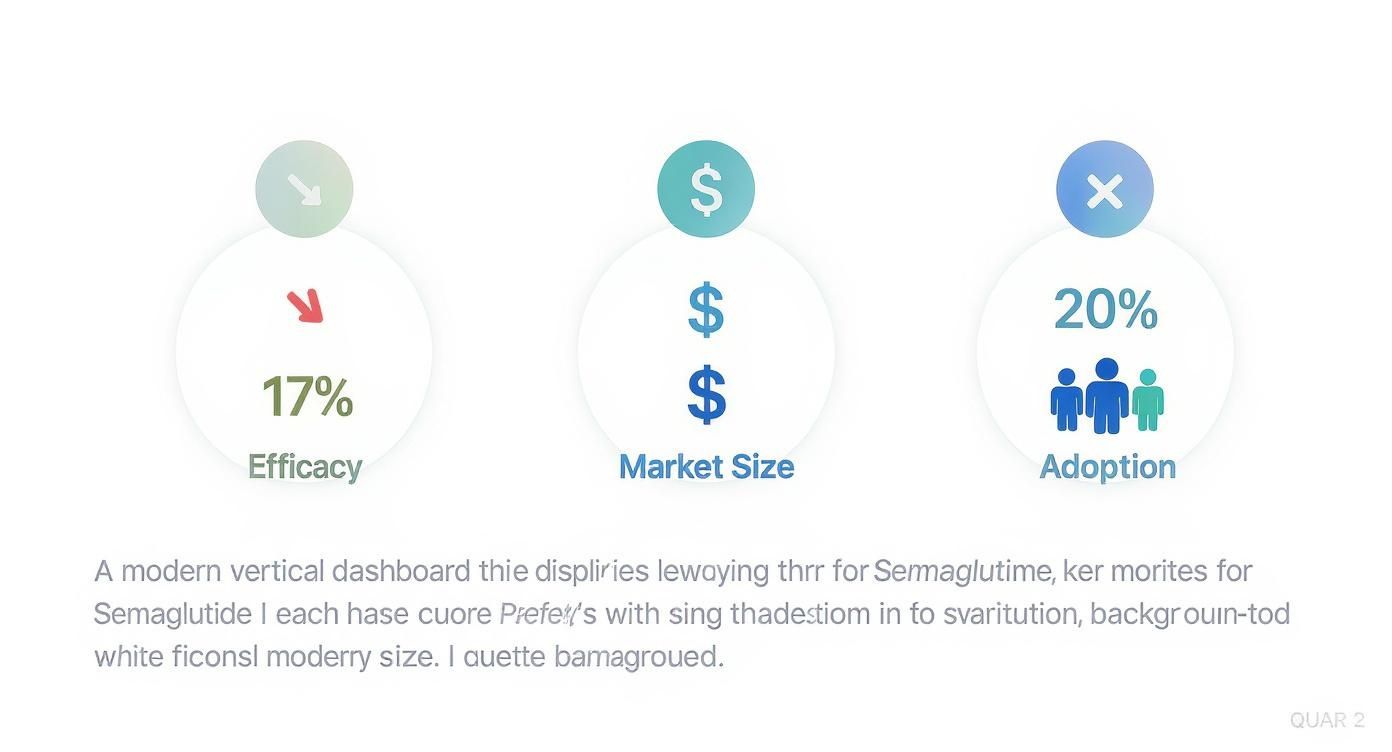
This visual really drives home how proven effectiveness fuels market demand, which in turn sparks more patient interest. It’s a feedback loop that continues to accelerate growth and discovery. These numbers are part of a much bigger trend, and if you want to zoom out, you can explore the data behind other similar treatments in our deep dive on peptide statistics.
To make these core numbers even clearer, here’s a quick summary table.
Key Semaglutide Statistics at a Glance
This table breaks down the most critical data points into three key areas: how well it works, how widely it's being used, and what that means for people considering it.
Metric Category | Key Statistic | Significance for Patients |
|---|---|---|
Clinical Efficacy | Average body weight loss of ~15% in pivotal trials. | Provides a realistic expectation for significant, clinically meaningful weight reduction. |
Market Adoption | 1 in 5 type 2 diabetes patients had an active GLP-1 prescription between 2022-2024. | Shows rapid acceptance by clinicians as a primary treatment, not just a niche alternative. |
Off-Label Use | ~25% of users do not have a type 2 diabetes diagnosis, indicating widespread use for weight management. | Highlights its dual role in treating both metabolic disease and obesity as a standalone issue. |
These statistics provide a solid, evidence-based foundation for understanding why semaglutide has become so prominent in health discussions.
What the Trends Indicate
The story is no longer just about managing diabetes. A huge driver of its growth is weight loss. One recent analysis of prescription data found that roughly one in four patients taking semaglutide or tirzepatide didn't actually have a type 2 diabetes diagnosis. This clearly points to its expanding role as a primary treatment for obesity.
This trend is being shaped by a few key forces working together:
Public Awareness: Media coverage and countless patient success stories have brought semaglutide into the mainstream consciousness.
Clinical Endorsements: Major medical organizations are updating their official guidelines to recommend these medications for managing obesity and cutting cardiovascular risk.
Evolving Coverage: Insurance companies and employers are constantly re-evaluating their coverage policies as demand soars and the long-term benefits become clearer.
All these factors are creating a dynamic environment where our understanding and use of semaglutide are changing almost in real-time.
What Do These Clinical Trial Numbers Actually Mean for You?
We hear a lot about the big clinical trials—STEP, SUSTAIN—and the impressive statistics they produce. These studies are the foundation for every prescription a doctor writes. But let's be honest, when you see a headline about a 15% mean body weight reduction, it can feel a bit abstract.
So, let's ground that in reality. For someone who weighs 200 pounds, a 15% loss isn't just a number; it's 30 pounds. That’s a game-changer. It’s the kind of weight loss that takes real strain off your knees and back, makes climbing stairs easier, and can fundamentally reshape your daily life.
The same goes for a term like a 1.8-point A1c improvement. It sounds like technical doctor-speak, right? But for a patient with type 2 diabetes, that drop could be the difference between living with a high risk for nerve damage or kidney disease and bringing their blood sugar into a much safer, more manageable range. These aren't just statistics; they're direct measures of improved health.

A Closer Look at the Weight Loss Data
The big, splashy number from the STEP 1 trial was the average weight loss: 14.9% over 68 weeks. That's a huge deal. But what I find even more compelling as a clinician is how consistently effective it was for so many people in the study.
It wasn't just a few super-responders pulling up the average. The results were widespread:
An incredible 86% of participants lost at least 5% of their body weight. That’s the threshold where we start to see real, tangible health benefits.
Nearly 70% of people lost 10% or more—a truly significant amount.
And get this: over a third of participants lost 20% or more of their starting weight.
This tells us that the results weren't just minor or cosmetic. For the vast majority, the weight loss was substantial enough to move the needle on their overall health and seriously reduce disease risk.
The Impact on Blood Sugar and A1c
For my patients with type 2 diabetes, managing blood sugar—measured by the Hemoglobin A1c test—is priority number one. This is where the SUSTAIN trial series gave us some incredibly clear insights.
Across those studies, patients on semaglutide saw their A1c levels fall by an average of 1.5 to 1.8 percentage points. To put that into context, an A1c over 6.5% is the benchmark for a diabetes diagnosis. A drop of this size can, and often does, pull a patient's A1c back below that critical threshold. That’s a massive win in managing their condition.
An important pattern emerged from all this data: the dose really matters. We consistently saw that higher doses of semaglutide led to better outcomes for both weight loss and A1c. This really underscores why it’s so crucial for patients to work with their doctor to carefully increase the dose over time to find what’s most effective for them.
The kind of robust data we see in these trials is only possible because of meticulous record-keeping. Tools like clinical voice charting tools are essential in the background, allowing researchers to accurately capture the detailed information needed to connect dosing to specific patient outcomes.
It's Not Just About Weight and Sugar
The story doesn't end with the scale or the glucose meter. What really excites me are the improvements we see in overall cardiometabolic health—the interconnected system that governs your risk for heart disease, stroke, and other major health events.
The trial data consistently highlights positive trends in other critical areas:
Blood Pressure: Participants saw meaningful drops in both their systolic and diastolic blood pressure, which directly reduces strain on the heart and blood vessels.
Cholesterol: Lab reports showed significant improvements, with lower triglycerides and LDL (the "bad" cholesterol).
Waist Circumference: This isn't just about fitting into old clothes. A smaller waist circumference points to a reduction in visceral fat, the dangerous fat that wraps around your organs and fuels inflammation and metabolic problems.
When you put it all together, these aren't just isolated numbers. They paint a picture of a broad-based reduction in the very risk factors that drive cardiovascular disease, our leading cause of death. The statistics show us that semaglutide does more than treat a symptom or two; it helps address the entire web of metabolic issues at once.
The Financial Boom: Charting Semaglutide's Market Explosion
The incredible clinical results of semaglutide are only half the story. As someone who's watched this unfold in the health space, it's impossible to miss the economic tidal wave that has turned this drug into a global phenomenon. Semaglutide's rise isn't just a health story; it's a massive financial one. Grasping these market dynamics is key to understanding everything from supply shortages to the future of drug development.
The numbers are simply mind-boggling. The global semaglutide market was recently valued at around USD 28.43 billion, and it's not slowing down. Projections show it could rocket to USD 93.60 billion by 2035, a staggering jump fueled by relentless demand. If you want to dig deeper into the data behind this growth, you can find a detailed breakdown in market findings from Grand View Research.
This isn't just steady, linear growth; it's accelerating. This is where a crucial financial metric comes into play: Compound Annual Growth Rate (CAGR).
CAGR: The Engine Behind Market Momentum
Think of CAGR as compound interest, but for a market's growth. It doesn't just measure the total increase from point A to point B. Instead, it gives you the average yearly growth rate, assuming the growth is compounding on itself each year. It’s the best way to smooth out the market’s bumps and see the real, underlying momentum.
For semaglutide, the projected CAGR is a very strong 10.5% over the next decade. That number tells everyone—from investors to entire healthcare systems—that demand isn't just holding steady. It’s building on itself, year after year.
This sustained growth is a direct reflection of a pressing public health need. The rising global rates of obesity and type 2 diabetes have created a massive, underserved population searching for effective treatments. Semaglutide arrived as a highly effective solution at the exact moment this need was reaching a critical point.
This powerful market engine impacts almost every part of the patient experience. The financial incentives are driving more research into next-generation GLP-1 drugs, pushing for better insurance coverage, and putting immense pressure on manufacturers to scale up. While semaglutide has been a dominant force, it’s also important to track its closest competitors. To see how its main rival measures up, you can review our guide to tirzepatide statistics.
The Forces Fueling the Fire
So, what's behind this financial explosion? It's not one single thing but a perfect storm of factors, each one feeding into the next and creating a powerful cycle of market expansion.
Here are the primary drivers catapulting the semaglutide market forward:
A Massive Unmet Need: For decades, progress in weight-loss medication was slow and disappointing, leaving a huge void. Semaglutide’s high efficacy filled that void perfectly, offering a real solution for both weight management and diabetes.
Expanding Medical Uses: The drug’s job description is getting longer. Landmark trials have shown it can deliver a 20% reduction in major adverse cardiovascular events, reframing it as a vital tool for preventative heart health.
Unprecedented Public Awareness: Thanks to endless media coverage and social media buzz, semaglutide is now a household name. This visibility drives patient demand, empowering more people to start conversations with their doctors.
Evolving Clinical Guidelines: As the evidence piles up, major medical organizations are rewriting their rulebooks. They now recommend GLP-1 agonists like semaglutide for a wider range of patients, cementing their role as a standard of care.
Put it all together, and you get a self-perpetuating cycle. More patients see results, which increases public awareness, which encourages clinical guidelines to adapt, which in turn fuels even more market growth and investment.
How People Are Using Semaglutide in the Real World
Clinical trials give us the clean, foundational data on semaglutide, but the real world is where the story gets messy—and far more interesting. Once a drug leaves the highly controlled environment of a study, we get to see how it truly behaves in daily life. Real-world prescription stats paint a vivid picture of staggering adoption rates, shifting patient profiles, and the undeniable power of public awareness.
From my own clinical experience, the speed at which semaglutide became a first-line tool has been nothing short of remarkable. Data from electronic health records confirms this observation. An analysis between early 2022 and mid-2024 showed that roughly one in five patients diagnosed with type 2 diabetes had an active prescription for a GLP-1 drug like semaglutide. That’s not a slow burn; it’s a seismic shift in how we manage metabolic health.
The Rise of Weight Management Use
One of the most significant real-world trends has been the explosion in semaglutide’s use for weight management, often entirely separate from a diabetes diagnosis. This wave started building momentum long before specific obesity approvals were in place, fueled by the stunning results coming out of the early trials.
A revealing look at over 1.5 million patient prescriptions for semaglutide or tirzepatide found something telling: about one in four of these patients had no record of a type 2 diabetes diagnosis. This stat confirms what many of us were seeing on the ground—a huge portion of its use is driven by its sheer effectiveness as a weight-loss therapy.
This pivot has been driven by a few key factors:
Public Demand: As success stories flooded social media and news outlets, patients started walking into clinics and asking for semaglutide by name.
Clinician Confidence: Seeing consistent, significant results firsthand gave doctors the confidence to prescribe it for obesity, which is finally being treated as the chronic disease it is.
Proactive Care: Many practitioners now see treating obesity not just as an end in itself, but as a powerful way to prevent type 2 diabetes and a host of other metabolic conditions from ever developing.
This forward-thinking approach is helping countless patients get ahead of their health issues. Continuous tracking is a huge part of this strategy. If you're interested in diving deeper, our guide on the benefits of continuous glucose monitoring breaks down how this technology is a game-changer for metabolic health.
Regional Differences in Adoption
Semaglutide's rollout hasn't been a monolith across the country. Prescription rates and patient access are heavily influenced by local factors like insurance plans, public health campaigns, and where the early-adopting doctors are concentrated. This creates a patchwork of usage that can look completely different from one state to the next.
In the United States alone, the semaglutide market is poised for substantial growth, expanding from approximately USD 8.17 billion to an estimated USD 17.29 billion by 2033.
California is a perfect example of a major regional hub. With its large, diverse population and high rates of both obesity and diabetes, it became fertile ground for early and widespread clinical adoption. It's a powerful illustration of how local health needs can put the accelerator on integrating new therapies. You can find more in-depth analysis on the U.S. semaglutide market and explore these regional dynamics further.
Demographic Trends in Patient Use
When we zoom in on who is using semaglutide, some clear demographic patterns start to appear. Recent survey data has shed light on some fascinating trends, especially around gender and age.
The numbers don't lie: women are using GLP-1 medications at higher rates than men, and that gap widens in certain age groups. For example, among people aged 30-49, women are more than twice as likely as men to have used these drugs for weight loss. The same pattern holds true for the 50-64 age bracket. These statistics hint that a mix of public health messaging, cultural norms, and personal health priorities are likely shaping who seeks out and ultimately receives these treatments. Understanding these user demographics is critical if we want to ensure fair access and support for everyone.
Understanding the Safety Data and Side Effect Rates
No conversation about semaglutide is complete without a practical, clear-eyed look at its safety profile. When I walk patients through these treatments, my first job is to cut through the noise and get straight to the numbers. Knowing the actual likelihood of side effects can transform fear into an informed decision about whether the benefits outweigh the risks for you.
It’s no surprise that the most common side effects are gastrointestinal. After all, the drug works by mimicking a hormone in your gut. These issues are almost always most noticeable when you first start the medication or when you step up to a higher dose.
The Most Common Side Effects by the Numbers
Clinical trial data gives us a really solid picture of what to expect. The good news is that for most people, the most common issues are manageable and tend to fade as their body gets used to the medication.
Here’s a quick rundown of what the major weight management trials found, showing the percentage of participants who reported these side effects:
Nausea: This is the most common one, reported by about 44% of people.
Diarrhea: Experienced by roughly 30% of participants.
Vomiting: Occurred in around 24% of individuals.
Constipation: Also a concern for about 24% of people in the trials.
These numbers are incredibly helpful because they give us perspective. Yes, nausea is common, but it also means over half of the people in the studies didn't report it. This kind of data helps set realistic expectations for that initial adjustment period.
The big takeaway here is that most of these side effects are mild, moderate, and temporary. They usually go away as your body adapts, which is exactly why following the slow, gradual dose increase schedule is so important. It's the key to minimizing discomfort and sticking with the treatment long enough to see results.
Putting Side Effects into Context
From a clinician’s perspective, these aren’t just statistics; they’re a playbook for helping patients succeed. For example, because we know nausea is the top issue, we can get ahead of it. We advise patients to eat smaller meals more often, steer clear of greasy or fatty foods, and drink plenty of water.
It's also crucial to remember that nearly all effective medicines come with a side-effect profile that requires some management. For more on how to think about this, you might find this a reassuring guide to understanding medication side effects helpful.
While gut-related issues are the main story, it’s vital to keep an open line of communication with your doctor about any new symptoms. This teamwork ensures that your treatment is not only effective but as safe as possible every step of the way.
Your Top Questions About Semaglutide, Answered
When you start digging into the data behind semaglutide, the numbers can be impressive, but they also bring up a lot of questions. I hear them from patients all the time. People want to know what these stats really mean for them, their health, and their future.
So, let's tackle the big ones. We'll look at how semaglutide truly stacks up against other options, the reality of what happens if you stop taking it, and why the news about its heart benefits is such a game-changer.
How Does Semaglutide Compare to Other Weight Loss Drugs?
In the landscape of anti-obesity medications, semaglutide (sold as Wegovy for weight loss) really raised the bar. When you look at the major clinical trials, like the STEP 1 study, you see patients losing, on average, around 15% of their starting body weight.
To put that in perspective, older medications just don't pack the same punch.
Phentermine-topiramate typically gets people to about 9-11% weight loss.
Liraglutide, an earlier GLP-1, is closer to the 5-8% range.
It’s not just about the average, either. The real story is how many people on semaglutide hit those major milestones, like losing more than 10% of their body weight. Of course, the field keeps moving. Newer drugs like tirzepatide (Zepbound), which acts on two different hormone receptors, are now posting even higher numbers, with some trial participants losing over 20% of their body weight.
What Does the Data Show About Regaining Weight After Stopping Semaglutide?
This is a critical question, and the research is pretty unequivocal: if you stop the medication, the weight tends to come back.
Follow-up studies that tracked people after the main clinical trials wrapped up paint a very clear picture. One analysis of the STEP 1 trial participants found that, just one year after stopping the drug, people had regained about two-thirds of the weight they'd worked so hard to lose.
This isn't a failure of the drug or the patient. It’s powerful evidence that obesity is a chronic disease, not a temporary problem. Just like you wouldn't stop taking blood pressure medicine once your numbers are stable, these findings suggest that for many, semaglutide is a long-term treatment, not a short-term fix.
Are the Heart Benefits Actually Meaningful?
Yes, and this is arguably the most exciting part of the semaglutide story. The cardiovascular statistics from trials like SELECT and SUSTAIN 6 aren't just statistically interesting—they represent a major shift in how we can protect patients.
The SELECT trial was a true landmark. It showed that in people with existing heart disease and overweight or obesity (but without diabetes), semaglutide cut the risk of a major cardiovascular event—like a heart attack or stroke—by a staggering 20%.
That 20% reduction is a huge deal. It’s concrete proof that the drug's effects go way beyond simple weight loss; it actively protects the cardiovascular system. This data was so compelling that it led to new FDA approvals and is fundamentally changing the way clinicians think about reducing heart disease risk in this population.
At Outlive Biology, our mission is to translate this kind of complex data into a clear, actionable health plan that’s built for you. Our data-driven membership combines continuous biometric monitoring with expert clinical oversight to show you what's really happening inside your body. We then design personalized protocols, which can include GLP-1 therapy, to help you hit your metabolic and longevity goals. To stop guessing and start measuring, learn more about our unique approach.
Live better for longer.
Research-backed tools, tactics, and techniques to maximize your health, delivered to your inbox every Monday.
Because real transformation starts with trust
and trust starts with clarity.
Founding Member Discount
Includes Devices + Labs
Cancel Anytime Before Activation