Smart Devices
Last Updated
Jan 2, 2026
Why a Simple Protein Calculator for Muscle Gain Falls Short
A basic protein calculator for muscle gain might give you a number, but from my professional experience, that’s just the starting line. If you’re serious about building muscle and optimizing for long-term health, that single, static figure is often insufficient.
I’ve seen it countless times in my practice: someone is told to "just eat more protein," and then they wonder why they aren't seeing the results they want. This type of generic advice is outdated, especially if your goals extend beyond muscle to include hormonal balance and metabolic health. Your protein needs are just that—yours.
It’s become crystal clear that what works for a 25-year-old athlete is completely different from what’s needed for someone navigating perimenopause or using TRT. These life stages can trigger something called "anabolic resistance." In simple terms, your body becomes less efficient at using protein to build muscle, meaning you actually need more of it just to achieve the same effect.
This guide is designed to move you beyond generic numbers. We'll start by establishing a solid, personalized baseline, and then I’ll show you how to fine-tune it using your own health data for results you can actually see and feel.
We'll examine the key variables that truly influence your protein requirements:
Your Age: Protein needs are not static; they evolve as we age to help counteract the natural decline in muscle mass.
Hormonal Status: Conditions like perimenopause, low testosterone, or even the use of GLP-1 medications can dramatically alter how your body processes protein.
Activity Levels: Wearable data isn't just for tracking steps. It can reveal how much stress your body is under, which is a direct signal that you need more protein to recover properly.
How to Calculate Your Foundational Protein Target
Let's establish the numbers. Moving past guesswork and calculating your foundational protein target is the most important first step. I'm going to walk you through the most effective, science-backed methods to provide a solid figure to anchor your entire nutrition plan.
For most active individuals, the simplest and most reliable starting point is calculating protein needs based on total body weight. It's straightforward, easy to remember, and provides an excellent estimate for fueling muscle growth and recovery.
The Grams Per Kilogram Method
This is the method you'll see used most often in sports nutrition research, and for good reason—it’s considered the gold standard. A landmark 2018 meta-analysis, which pooled data from numerous studies, found that 1.6 grams of protein per kilogram of body weight is an effective target for maximizing lean mass during resistance training.
Let's break that down with an example. If you weigh 180 lbs (which is about 82 kg), you’d be aiming for roughly 131 grams of protein every day. You can discover more about these protein findings and how they apply to your specific goals.
Here's the simple math:
Your Weight in Pounds (lbs) ÷ 2.2 = Your Weight in Kilograms (kg)
Your Weight (kg) × 1.6 = Your Foundational Protein Target (grams)
So, if you weigh 150 lbs:
150 lbs ÷ 2.2 = 68 kg 68 kg × 1.6 g/kg = 109 grams of protein per day
The flowchart below visualizes how we move from a generic, one-size-fits-all recommendation to a truly personalized protein strategy that accounts for you.

The key takeaway is simple: ditching cookie-cutter advice for a strategy built around your body and goals is the most effective way to achieve the specific results you're after.
A Quick Comparison of Protein Calculation Methods
Before we go deeper, it's helpful to see the most common methods side-by-side. Each has its place, but some are more precise than others.
Here's a quick reference table comparing four popular approaches. I've used a 180 lb (82 kg) individual with an estimated 20% body fat as the example for consistency.
Calculation Method | Formula | Example Calculation (180 lbs / 82 kg) | Best For |
|---|---|---|---|
Grams per Kilogram | Weight (kg) × 1.6-2.2 g | 82 kg × 1.6 g = 131 g | The most common, scientifically-backed starting point for active individuals. |
Grams per Pound | Weight (lbs) × 0.7-1.0 g | 180 lbs × 0.8 g = 144 g | A quick and easy calculation for those more familiar with the imperial system. |
Lean Body Mass | Lean Mass (kg) × 2.2-2.75 g | 65.6 kg LBM × 2.3 g = 151 g | A more precise method for leaner individuals or those with higher body fat. |
Percentage of Calories | Total Daily Calories × (20-30%) | 2500 kcal × 25% = 625 kcal ÷ 4 = 156 g | Integrating protein goals within a structured macronutrient and calorie plan. |
As you can see, the final number can vary depending on the formula you use. The grams per kilogram method is a fantastic and reliable place to start, but as you become more advanced, using lean body mass or a percentage of total calories can offer a more refined target.
Fine-Tuning Your Protein Target for Your Unique Biology
Your initial protein calculation is a solid starting point, but it's just that—a start. True optimization occurs when you begin to fine-tune that number based on your specific life stage, hormonal profile, and overall health picture. Personalization is what unlocks meaningful, sustainable results.
Think about it. Significant hormonal shifts, like those that occur during perimenopause or when starting Testosterone Replacement Therapy (TRT), can trigger a state known as anabolic resistance. This is a clinical term meaning your body becomes less efficient at using the protein you eat to build muscle. To achieve the same muscle-building response, you simply need more of it.
Understanding your hormonal health, perhaps by looking at your https://outlive.bio/blog/free-androgen-index, provides the context needed to make these crucial adjustments.
How Hormones and Health Conditions Change the Game
Your hormonal status is one of the most significant variables in this equation. For men on TRT, for example, increasing protein intake to around 1.8 g/kg can make a dramatic difference. One compelling study showed that this higher-protein strategy essentially doubled the muscle gain someone would get from TRT alone. You can dive into the full research on how protein amplifies hormonal therapy if you're curious.
Your protein target isn't static. It should be a dynamic number that evolves with you, supporting your goals through every phase of your life.
Using Personal Data To Refine Your Protein Needs
Establishing a baseline for your protein intake is a great start, but true personalization comes from layering in your personal health data. This is where you move from a good estimate to a tailored plan. Your wearables and lab results contain clues that can help you turn that static protein target into a dynamic, responsive strategy. I have always built my approach around a simple feedback loop: track, analyze, and adjust.
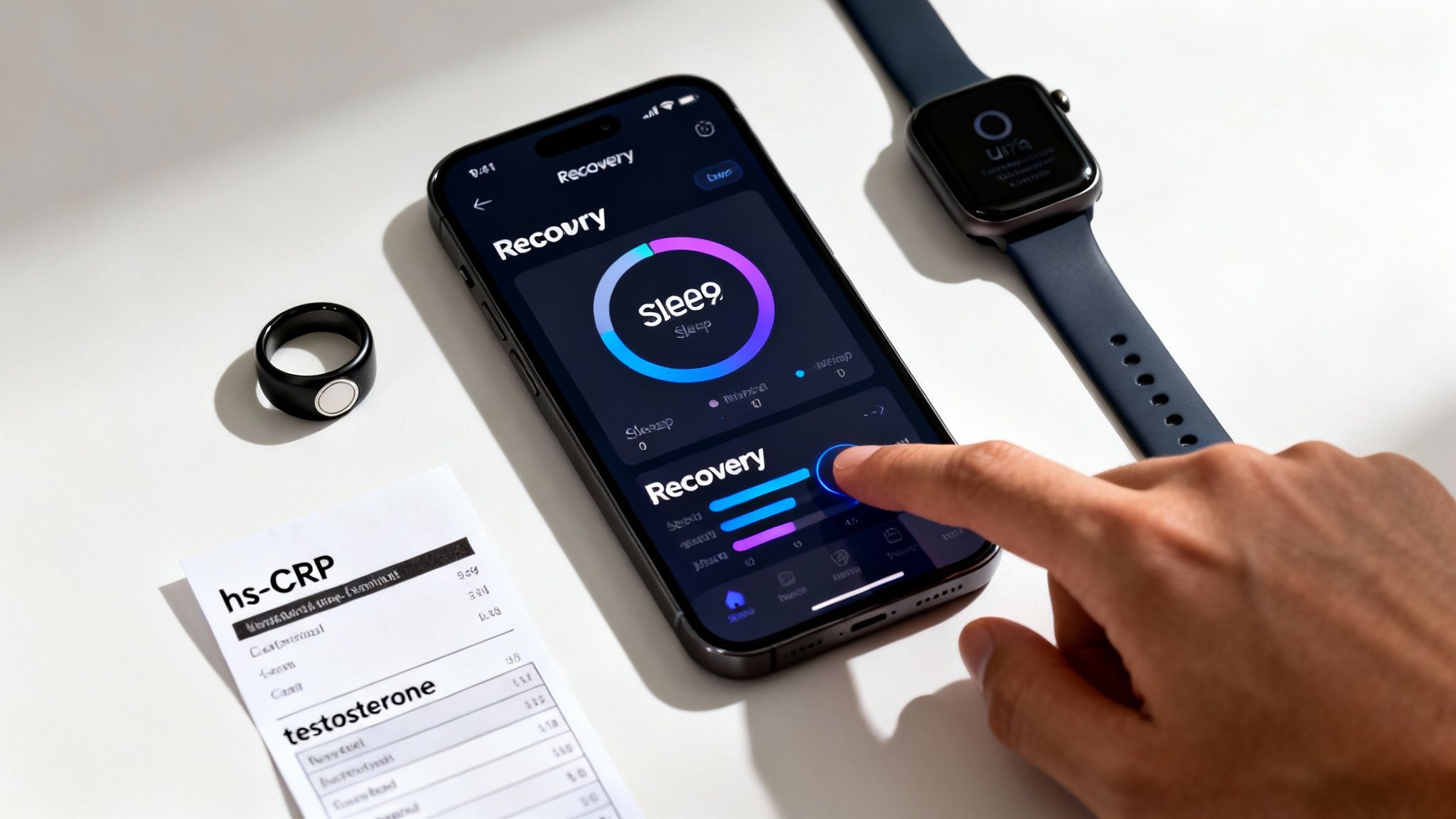
Consider this: if your wearable device shows a string of poor recovery scores after a few hard workouts, that’s a clear signal. It could mean your body requires more building blocks to repair tissue damage. An increase in your protein intake might be precisely what you need.
The same logic applies to your lab work. Markers like hs-CRP (a sign of inflammation) or your testosterone levels provide critical context. If inflammation is high, your body is in a state of stress and may demand more protein to cope and recover.
Connecting Your Data for Better Outcomes
This data-driven approach is essential during specific phases, like when you're in a calorie deficit or navigating hormonal shifts.
For instance, when cutting calories to lose fat, muscle preservation is paramount. Pushing your protein intake into the 1.6-2.2 g/kg range can help you retain significantly more muscle than you would on a standard diet.
And don't forget sleep. Pairing your nutritional strategy with data from your wearable is key. Just one night of poor rest can reduce muscle protein synthesis by as much as 18%. That data point alone highlights the importance of prioritizing both recovery and nutrition.
To put this into practice, you need a reliable way to track your food. To see what you're actually consuming and adjust on the fly, it’s worth checking out some of the 12 best food tracking app options.
Making Your Personalized Protein Plan a Reality
Determining your daily protein number is a great start, but consistent application is where results are made. From my professional experience, the most effective and sustainable approach is to distribute your protein intake evenly throughout the day.
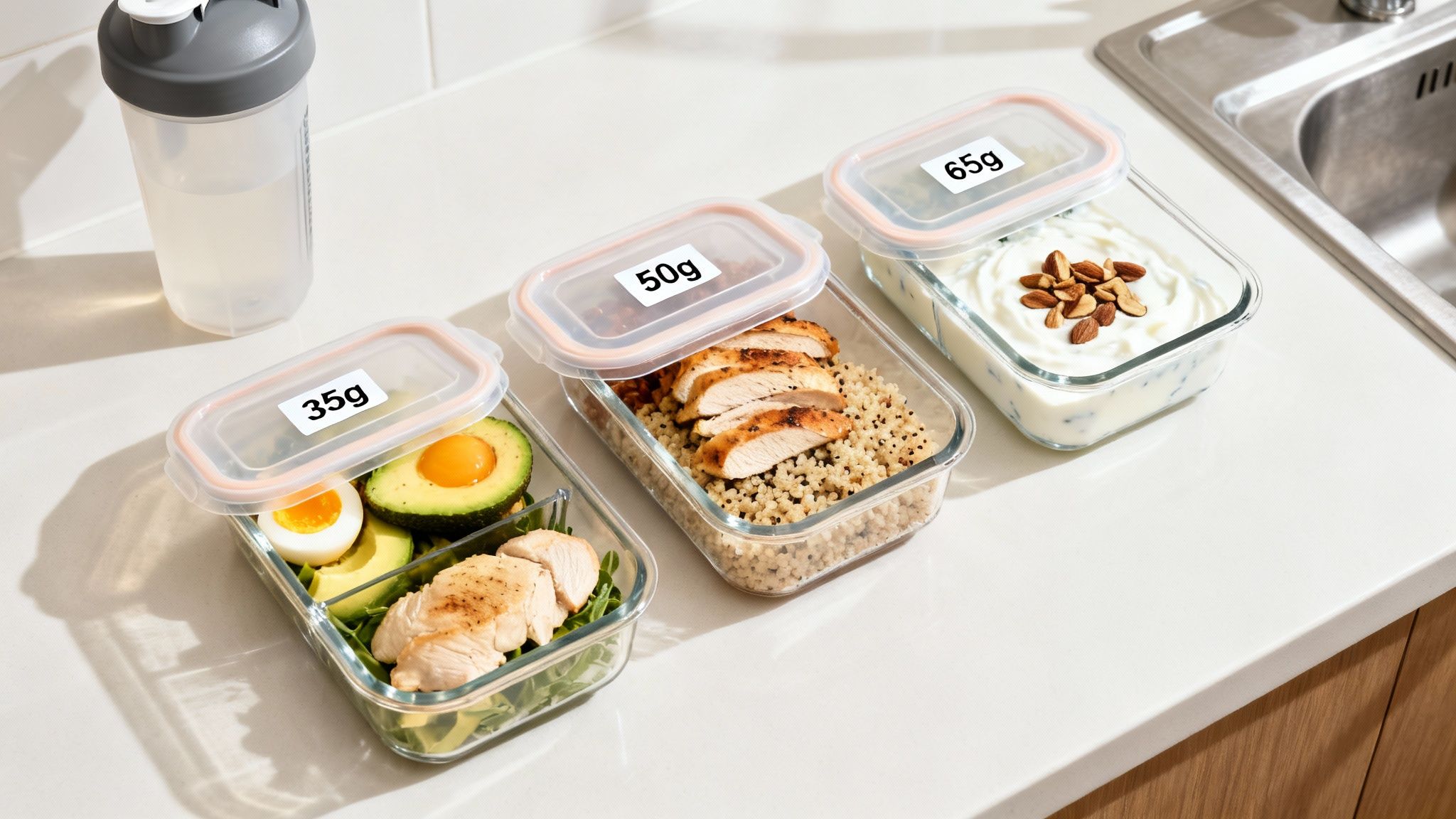
Aiming for roughly 30-40g of protein per meal is a solid benchmark. This strategy helps maintain consistent muscle protein synthesis and has the added benefit of promoting satiety.
This even-distribution method works well for both animal-based and plant-based proteins. If you rely more on plant sources, it's crucial to understand how to combine them to create a complete amino acid profile. Exploring resources on effective plant-based protein for muscle building can offer excellent strategies.
What Hitting a 150g Protein Target Actually Looks Like
Let's break down how you can reach a 150g goal with real food. It's often simpler than it seems.
Breakfast: A bowl of Greek yogurt topped with a handful of nuts easily provides 35g.
Lunch: A large salad with a grilled chicken breast can contribute about 40g.
Snack: A post-workout whey protein shake is a quick way to add another 30g.
Dinner: A standard-sized salmon fillet with a side of quinoa can round out the day with 45g.
For a clearer picture of your progress, try tracking your food intake alongside biometric data from a wearable device. This creates a powerful feedback loop.
Answering Your Top Protein Questions
Let's address a few common questions that arise when discussing protein. Clearing up these myths and concerns can help you move forward with confidence.
"Will a High-Protein Diet Damage My Kidneys?"
This is a frequent concern, but for most people, it is unfounded. The belief that a high-protein diet is inherently bad for kidney health is a persistent myth not supported by scientific evidence for healthy individuals.
Major studies have repeatedly shown that protein intakes even as high as 2.2 g/kg—well within the optimal range for muscle growth—do not negatively impact kidney function in people with healthy kidneys.
Of course, it's always wise to monitor your health with regular lab work. I recommend reviewing key markers like creatinine and your estimated Glomerular Filtration Rate (eGFR) with your physician. But for the vast majority of active adults, a higher protein intake is perfectly safe.
"Should I Lower My Protein on Rest Days?"
My short answer is no. Consistency is your best ally here.
Muscle repair and growth is a process that continues long after you leave the gym. In fact, the 24-48 hour window after a challenging workout is when muscle protein synthesis is at its peak.
I often refer to rest days as "growth days." Maintaining your protein intake on these days ensures your muscles have a steady supply of the amino acids they need to rebuild and become stronger. Do not shortchange your recovery.
"Is It Possible to Build Muscle on a Plant-Based Diet?"
Absolutely. It simply requires more thoughtful planning.
The main challenge with plant-based protein is ensuring you get a complete amino acid profile. Unlike most animal proteins, individual plant sources are often "incomplete," meaning they are low in one or more essential amino acids.
The solution is simple: combine different sources. Classic pairings like rice and beans, for example, together provide all the essential amino acids. You might also need to aim for a slightly higher overall protein target to compensate for the lower digestibility of some plant sources. With the right strategy, building muscle can be just as effective.
Ready to stop guessing and start using your unique health data to optimize your nutrition? Outlive Biology turns your biometrics into a clear, actionable plan for better health, performance, and longevity. Discover how data-driven care can transform your results at https://outlive.bio.
Live better for longer.
Research-backed tools, tactics, and techniques to maximize your health, delivered to your inbox every Monday.
Because real transformation starts with trust
and trust starts with clarity.
Founding Member Discount
Includes Devices + Labs
Cancel Anytime Before Activation