Statistics

Last Updated
Jan 2, 2026
It's clear from recent American dieting statistics that a massive number of us are actively trying to eat better. From my own experience working in health, I've seen this firsthand. More than half of all adults in the U.S. are focused on changing their eating habits, making diet a major part of our national conversation around health and wellness.
This isn't just a trend; it's a significant cultural and economic driver, and it's something I've personally navigated on my own health journey.
A Snapshot of Dieting in America Today
The decision to change how you eat is always a personal one, yet it's an experience shared by tens of millions. It usually kicks off with a simple goal: feeling better, getting more energy, or managing weight. I know that feeling well. This shared pursuit is what we see reflected in the numbers, which point to a huge shift toward more conscious eating nationwide.
This desire for a healthier life is more than a passing fad for most people. It represents a real commitment—a fundamental change in how we view food and its direct link to our long-term well-being.
Generational Divides in Dietary Habits
What's really interesting is how this commitment to dieting breaks down across different age groups. It turns out, younger generations are the ones truly leading the charge.
A recent survey found that 54% of all American adults followed a specific diet or eating pattern in the past year. But when you look closer, the generational gap is stark. A whopping 66% of Gen Z and 64% of Millennials are actively dieting, compared to 52% of Gen X and just 42% of Baby Boomers.
This data, highlighted in research from the Johns Hopkins Center for a Livable Future, points to a real cultural shift. Younger people are just more engaged with nutrition and wellness information. The infographic below really drives this point home.
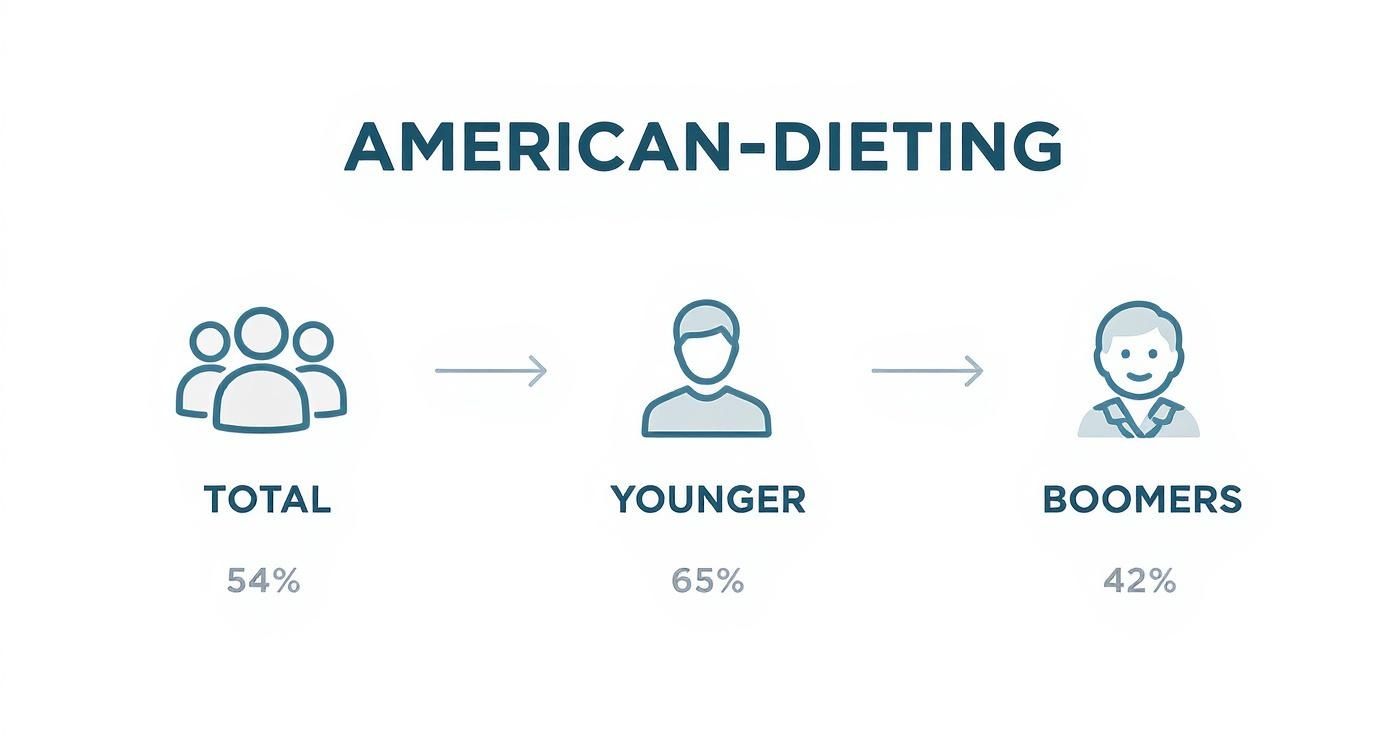
Looking at the data this way, it's plain to see: younger Americans are nearly 55% more likely to be on a diet than Baby Boomers. It’s a clear illustration of how our health priorities and motivations change as we move through different stages of life.
Key American Dieting Trends at a Glance
To put these numbers in perspective, here's a table summarizing the key trends we're seeing in American dieting habits.
Statistic | Key Finding | Generational Insight |
|---|---|---|
Overall Dieting Rate | 54% of U.S. adults followed a specific diet in the past year. | A majority of the population is actively engaged in dietary changes, signaling a widespread health focus. |
Gen Z & Millennials | 66% and 64% respectively are dieting, leading all other age groups. | Younger generations are the primary drivers of modern dietary trends and wellness culture. |
Baby Boomers | Only 42% report following a diet, the lowest of any generation. | This group is significantly less likely to adopt structured eating patterns than their younger counterparts. |
Adoption Likelihood | Younger adults are nearly 55% more likely to diet than Baby Boomers. | Highlights a major shift in how different generations approach nutrition and personal health. |
This data paints a compelling picture of a nation increasingly focused on nutrition, albeit with different levels of engagement across generations.
Why Are So Many Americans Dieting?
The reasons behind this intense focus on diet are complex. While weight loss is definitely a major driver, it's far from the only one. Many are looking for more energy, better athletic performance, or a way to manage a specific health condition.
For a lot of people, the goal isn't just about the number on the scale anymore. If you're curious about how we measure body composition, you might find our guide on whether BMI scales are accurate helpful.
The core motivation for dieting is shifting from purely aesthetic goals to a more holistic pursuit of metabolic health and longevity. People want to feel good and function at their best, not just lose weight.
This broader view is what's really important here. It moves the conversation away from quick, short-term fixes and toward building sustainable, long-term strategies for a healthier life. When we understand these motivations, we can see the American dieting statistics not just as numbers, but as a reflection of a population genuinely trying to live better.
Who Is Dieting? A Look at the Demographics

The big-picture numbers on dieting are fascinating, but the real story unfolds when you dig into who is actually trying to change the way they eat. The dieting landscape in America isn't a single, uniform picture. It's more of a mosaic, pieced together from different ages, genders, and life experiences, each with its own set of motivations and hurdles.
Looking at these demographic patterns helps us see the human stories behind the statistics. Things like age and gender don't just change the "why" behind dieting; they fundamentally shape the entire approach.
Age and Gender Differences in Dieting
If you look at the data over time, one thing is clear: women have consistently been more likely than men to report being on a diet. This gap often reflects deep-seated societal pressures, but it also points to distinct health concerns that shift throughout a woman's life.
For example, the metabolic curveballs thrown by perimenopause and menopause can make weight management feel like an uphill battle. It's why specialized weight loss programs for women over 50 have become so crucial—they're designed to work with, not against, these biological shifts. On the other hand, men might be more drawn to diets that promise to build muscle or boost cardiovascular health, showing just how much our goals can diverge.
As we've seen, younger generations are much more likely to adopt very specific eating patterns, often driven by social media trends and a strong desire for "clean" or sustainable foods. Meanwhile, older adults are more likely to stick with the tried-and-true, medically advised diets they've known for years.
The Influence of Income and Education
Socioeconomic status might be the single most powerful predictor of someone's dietary habits. Time and again, studies show that higher income and education levels are linked to healthier eating. This isn't a matter of willpower; it’s about access and opportunity.
Just think about the cost of food. A diet packed with fresh fruits, vegetables, and lean proteins is almost always more expensive than one built on highly processed, packaged foods.
According to the World Bank, the average cost of a healthy diet globally reached $4.46 per person per day in 2024. For a family of four, that adds up fast, creating a massive affordability barrier for millions.
This economic reality forces many lower-income households toward cheaper, calorie-dense foods that are poor in nutrients. It's a cruel paradox where the people with the fewest resources are at the highest risk for diet-related diseases.
Higher Education: This often goes hand-in-hand with greater health literacy, making it easier to decipher nutrition labels and follow complex medical advice.
Lower Income: People in this bracket are more likely to live in "food deserts," areas where fresh, affordable food is hard to come by.
Time Constraints: When you're working multiple jobs or long hours, you have less time to cook. Suddenly, convenient processed foods don't just seem appealing—they seem necessary.
Geographical and Cultural Patterns
Where you live also has a huge say in what you eat. People in urban, coastal areas generally have better access to a wide variety of healthy foods and are often immersed in a culture that embraces wellness trends. In contrast, those in rural or inland regions might have fewer grocery options and a greater reliance on traditional cuisines that can be heavier.
Beyond the map, our cultural backgrounds shape our relationship with food on a profound level. What we eat is deeply personal, tied to our families, communities, and traditions. To truly understand these American dieting statistics, we have to appreciate how all these different threads weave together to create a complex and incredibly varied picture of health across the country.
The Most Popular Diets and Why They Trend
If you feel like you're hearing about a new "it" diet every few months, you're not wrong. The world of nutrition is constantly shifting, with new trends capturing our collective attention. But when you look closely, you can see a larger story unfolding—one that’s less about quick-fix fads and more about a fundamental change in how we think about food.
Americans are moving away from overly complicated, restrictive plans. Instead, people are searching for sustainable frameworks that fit a modern lifestyle, focusing on feeling strong, energized, and in control. The diets that stick around are the ones that feel intuitive and are backed by real health benefits.
The Rise of Protein and Plant-Forward Eating
Two of the biggest movements shaping how Americans eat today are the push for high-protein diets and the explosion of plant-forward eating. They might sound like they're on opposite ends of the spectrum, but they're both rooted in the same idea: trading empty calories for foods packed with nutrients.
High-protein diets have gone mainstream for a reason. They're incredibly effective for building muscle, yes, but also for keeping you feeling full and stabilizing blood sugar. This isn't just for elite athletes anymore; it's for anyone trying to manage their appetite and support their metabolic health throughout the day.
At the same time, plant-forward eating—which is more about adding plants than strictly eliminating meat—has surged in popularity. This trend is fueled by a mix of personal health goals and growing concerns about environmental sustainability. Younger generations, in particular, are leading this charge, redefining a healthy plate by prioritizing whole foods over heavily processed options.
This cultural pivot toward whole foods isn't just a niche trend. It's starting to reshape some of America's most deeply ingrained habits, including our relationship with fast food.
While fast food is still a significant part of the American landscape, its hold is starting to slip. Recent data revealed that 32% of U.S. adults ate fast food on any given day, a noticeable dip from past years. This decline is largely thanks to younger adults cutting back. You can discover more about this shift in American eating habits to see what it signals for the future of food.
The Enduring Appeal of Legacy Diets
While new trends make a lot of noise, some dietary patterns have stood the test of time because they just plain work. These "legacy diets" remain staples because they offer structure without demanding extreme sacrifices, making them sustainable long-term strategies instead of short-lived fads.
To make sense of the most common approaches, it helps to see how they stack up against one another.
Comparing Popular American Dietary Approaches
This table breaks down the core ideas and goals behind the dietary frameworks that consistently top the charts in the U.S.
Diet Type | Core Principle | Primary Health Goal |
|---|---|---|
Mediterranean Diet | Emphasizes whole foods: fruits, vegetables, whole grains, olive oil, and fish. | Heart health, longevity, and reduced inflammation. |
Low-Carbohydrate | Limits carbohydrates from sources like grains and sugar to encourage fat burning. | Weight loss, blood sugar control, and improved metabolic markers. |
Intermittent Fasting | Cycles between periods of eating and fasting, focusing on when you eat, not just what. | Weight management, cellular repair, and metabolic flexibility. |
Plant-Based | Focuses on foods primarily from plants, including fruits, vegetables, and legumes. | Improved cardiovascular health, lower disease risk, and environmental sustainability. |
Each of these has its own philosophy, but notice how they all point toward whole, minimally processed foods.
Take the Mediterranean diet, for example. It consistently ranks as one of the best overall approaches year after year. Its secret? It’s flexible and focuses on adding delicious, nutrient-dense foods rather than on deprivation. It feels less like a diet and more like a satisfying way of life, which is precisely why so many people can stick with it for good.
Why Some Diet Trends Fade Away
For every diet that becomes a long-term staple, dozens more burn out after a flashy debut. The ones that fail to catch on for the long haul almost always share a few fatal flaws.
They are overly restrictive: Any plan that demonizes and eliminates entire food groups (without a clear medical reason) is incredibly difficult to maintain and can even lead to nutrient gaps.
They require expensive or hard-to-find ingredients: If a diet isn't practical for an average person's budget or lifestyle, it's dead in the water. Accessibility is everything.
They lack scientific backing: We live in an age of information overload, and people are getting better at spotting pseudoscience. Diets built on flimsy evidence or celebrity hype just don't have staying power.
At the end of the day, the diets that succeed are the ones that are adaptable, balanced, and grounded in solid nutritional science. The trends we're seeing in American dieting show a clear move toward approaches that promote overall well-being, reflecting a more informed and mature perspective on what it really means to eat well.
The Link Between Obesity and Economic Realities

If so many Americans are trying to lose weight, why do obesity rates keep climbing? It’s one of the most frustrating paradoxes in public health. The answer, it turns out, has less to do with individual willpower and much more to do with the economic and environmental realities we face every day.
From my own experience, I know how this feels. You can have the best intentions and a solid plan, yet still run into barriers that make healthy eating feel like an impossible uphill climb. This disconnect between effort and outcome isn't just a personal story; it’s a national one reflected in the data.
The latest American dieting statistics paint a pretty stark picture. Despite a widespread focus on dieting, obesity rates remain stubbornly high. A recent report from the Trust for America's Health revealed that 40% of American adults now have obesity. This isn't from a lack of trying. A Pew Research Center survey found that 90% of adults believe healthy food is more expensive, and 69% say rising prices make it harder to eat well. You can discover more about these public health findings to see just how tightly economic pressures are squeezing our dietary choices.
The High Cost of Healthy Eating
Let's be direct: eating healthy costs more. When you’re standing in the grocery aisle, the choice between a bag of apples and a box of processed snack cakes often boils down to your budget, not just nutrition. Fresh produce, lean proteins, and whole grains simply carry a higher price tag than their calorie-dense, nutrient-poor alternatives.
This price gap creates a huge economic barrier, hitting lower-income households the hardest. When every dollar counts, affordable calories often win out over expensive nutrients. This isn't a failure of discipline; it's a rational economic decision millions of families are forced to make every single day.
This economic reality means that for many, a diet rich in whole foods is simply out of reach. It highlights a systemic problem where our health is directly tied to our financial stability—a factor that’s too often ignored in the dieting conversation.
Food Deserts and Swamps
Beyond cost, there's the issue of simple access. Millions of Americans live in food deserts—neighborhoods where finding affordable, fresh food is a real challenge. In these areas, the nearest full-service grocery store might be miles away, leaving residents to rely on convenience stores and fast-food chains for their meals.
At the same time, many of these communities are also food swamps, places saturated with outlets selling ultra-processed, high-calorie foods. When your only options are a burger joint, a pizza place, and a corner store stocked with chips and soda, making a healthy choice becomes nearly impossible.
This kind of environment shapes eating habits from a young age and reinforces cycles of poor nutrition.
Limited Options: A lack of full-service grocery stores severely restricts access to fresh fruits, vegetables, and other whole foods.
Convenience Factor: For time-strapped families, the low cost and convenience of fast food can be an irresistible combination.
Marketing Overload: Food swamps are typically flooded with advertising for unhealthy products, making them the default, top-of-mind choice.
The Challenge of Ultra-Processed Foods
Finally, we have to talk about the food itself. Our modern food supply is dominated by ultra-processed foods (UPFs). These aren't just foods with a few added ingredients; they are industrial formulations engineered to be cheap, convenient, and hyper-palatable—a scientific term for being almost addictive.
These products are stripped of fiber and nutrients while being loaded with added sugars, unhealthy fats, and sodium. They're designed for a long shelf life and maximum profit, not for optimal human health.
The sheer availability and affordability of UPFs create a food environment that actively works against our health goals. Even with the best intentions, it's a tremendous challenge to navigate a world where these foods are the easiest, cheapest, and most heavily marketed option. This shows that the struggle with diet and weight isn't just a personal issue—it's a societal one, rooted in economics and the very structure of our food system.
Do Diets Even Work? A Look at the Real-World Success Rates
We've talked about why people diet and how they do it, but let's get to the question that really matters: does any of this actually work? When you dig into the data on dieting in America, you see a ton of people trying, but the numbers on long-term success tell a more frustrating story. It’s a cycle most of us have felt personally—that initial rush of seeing the scale go down, only to watch the pounds creep back on.
This cycle of losing and regaining isn't just common; it's practically the norm. While nearly any diet can deliver results in the short term, study after study confirms that the vast majority of people regain most, if not all, of that lost weight within a few years. This isn't a moral failing or a lack of willpower. It's a biological battle. Our bodies are hardwired to see weight loss as a threat, and they fight back by slowing down our metabolism and cranking up hunger signals.
Getting your head around this biological reality is the first real step toward finding a strategy that can actually last.
The Weight Regain Rebound
The statistics on keeping weight off for good can be pretty sobering. Research consistently shows that while many people manage to lose a meaningful 5-10% of their body weight in the first six months of a diet, up to two-thirds of that weight is often back within a year. Look out five years, and the regain numbers are even higher for most.
This up-and-down pattern, often called "weight cycling," can do a number on your metabolism. It’s a harsh reminder that there’s a massive difference between a temporary diet and a true lifestyle change.
To break this cycle, you have to think beyond just cutting calories. We need to look at how different ways of eating affect the incredibly complex systems that control our energy, hunger, and metabolism.
Beyond the Scale: What Really Matters for Your Health
A truly successful eating strategy does more than just make you weigh less. The best approaches create real, measurable improvements in your metabolic health markers—the internal data points that paint a true picture of your well-being.
So, what should you be tracking?
Blood Sugar Control: An approach that keeps your glucose levels stable and lowers insulin resistance is a powerful tool for preventing conditions like type 2 diabetes.
Lipid Profile: You want to see better cholesterol and triglyceride numbers, which are absolutely critical for protecting your heart.
Inflammation Levels: Lowering chronic, systemic inflammation is one of the best things you can do to reduce your risk for a whole host of diseases.
Different diets hit these targets in different ways. Low-carbohydrate plans, for example, often deliver impressive results for blood sugar management, while the Mediterranean diet has earned its reputation for being fantastic for heart health.
A Reality Check on the Data
We also have to be honest about the data we're working with. Nutrition science is messy. Most of the big studies have to rely on people self-reporting what they ate, which is notoriously unreliable. On top of that, "success" is defined differently from one study to the next, making it impossible to crown one single diet as the undisputed champion for everyone.
Plus, how you respond to a diet is deeply personal, influenced by your genetics, your lifestyle, and your unique health profile. This is exactly why personalized, clinician-guided care is taking center stage. New treatments and a much deeper understanding of our individual biology are completely changing the game. For a look at the clinical side of this evolution, these **semaglutide statistics** show how medical tools are reshaping the conversation around weight.
In the end, the data points to a simple truth: the best "diet" is the one you can actually live with, one that actively improves your metabolic health, and one that feels like a natural part of your life, not a punishment.
Making Sense of the Statistics for Your Own Health
After digging through all this data, one thing becomes crystal clear: there's no magic bullet diet that works for everyone. The most effective eating strategy is always going to be the one that fits you—your unique biology, your daily life, and what you actually want to achieve long-term. Instead of jumping on the next fad, you can use these broader trends to build a smarter, more personalized plan.
In my experience, both personally and professionally, lasting change has nothing to do with perfection. It's all about consistency. The most powerful results come from small, sustainable choices that you can repeat day in and day out. For example, focusing on nutrient-dense foods gives your body the raw materials it needs to thrive, which is a much smarter approach than simply obsessing over calorie counts.
From Data to Daily Practice
So, how do you turn these national statistics into something you can actually use? It starts by shifting your mindset away from rigid, restrictive rules and toward flexible, guiding principles. A healthy way of eating should feel energizing and empowering, not like a chore. Think of it less as a short-term diet and more as building a foundation for a long, healthy life.
Here are a few core concepts that can help guide you:
Prioritize Whole Foods: Try to build the bulk of your meals around foods that are as close to their natural state as possible. Think vegetables, fruits, lean proteins, and whole grains.
Understand Your Body’s Signals: Start paying attention to your own hunger and satiety cues. A huge piece of this puzzle is learning how to balance blood sugar levels naturally, as this can dramatically impact your appetite and energy throughout the day.
Incorporate Joyful Movement: Nutrition's best friend is physical activity. To support your goals without putting undue stress on your body, you might want to explore some of the best low-impact workouts for weight loss.
Creating a Sustainable Path Forward
At the end of the day, the goal is to create a lifestyle that supports your health without feeling like a constant struggle. The data is pretty clear that extreme diets often backfire, leading to frustration and rebound weight gain. A more moderate and consistent path is far more likely to get you where you want to go—and keep you there.
By focusing on these sustainable principles, you can finally step off the dieting rollercoaster and start building a life of genuine, long-term well-being.
Common Questions About Dieting in America
After digging into the data on dieting trends, demographics, and outcomes, you're probably left with a few practical questions. It's one thing to see the numbers, but it's another to figure out what they mean for your own health. Let's tackle some of the most common questions that come up.
What's the Single Best Diet Out There?
If the data tells us anything, it's that there’s no magic bullet. There is no single "best" diet that works for every person, every time.
Sure, some approaches are better for specific goals—a low-carb diet can be great for getting blood sugar under control, and a Mediterranean-style eating pattern is fantastic for heart health. But the most successful diet, hands down, is the one you can actually stick with long-term. Consistency trumps everything. The best plan is one built around whole foods that actually fits your real life, your budget, and the foods you genuinely enjoy.
So, Why Do Most Diets Seem to Fail?
It’s not a lack of willpower. Most diets fail because they’re fighting an uphill battle against both our biology and the realities of modern life. When you lose weight, your body instinctively fights back by slowing down your metabolism and cranking up hunger hormones. This makes regaining the weight incredibly common.
On top of that, so many popular diets are just too restrictive. They're expensive, a pain to follow in social situations, and frankly, joyless. That's not a recipe for long-term success. Lasting change comes from building flexible habits you can live with for years, not from following a rigid plan you can only tolerate for a few weeks.
How Many Americans Are Actually Dieting Right Now?
A huge number. The latest American dieting statistics show that about 54% of adults in the U.S. said they followed a specific diet or eating plan in the past year. That's more than half the country.
And the trend is even more pronounced in younger groups. Roughly 65% of Millennials and Gen Z are actively trying to change how they eat. It’s clear that health and nutrition have become a major focus for people across the board.
If Not Weight, What Should I Be Focusing On?
Obsessing over the number on the scale can be a trap. A much smarter approach is to focus on improving the health markers that truly reflect what’s happening inside your body—your metabolic health.
Instead of fixating on weight, try tracking these key indicators:
Blood Sugar Levels: Keeping your glucose stable and improving how your body responds to insulin is fundamental.
Lipid Profile: You want healthy cholesterol and triglyceride numbers for a happy heart.
Blood Pressure: Getting this into a healthy range is one of the most powerful things you can do to lower your risk for heart disease.
Inflammation Markers: Chronic inflammation is a root cause of many diseases, so bringing it down is a huge win.
When you shift your focus to these metrics, you start measuring what really matters. It’s about genuine, lasting health improvements, not just a fleeting number on the scale.
At Outlive Biology, we believe understanding your own data is the key to unlocking your best health. We go beyond generic advice by taking your personal biometrics from wearables, lab tests, and vitals and turning them into a clear, actionable plan. Our clinician-led approach combines continuous monitoring with expert guidance to help you optimize your metabolic health, balance your hormones, and build a lifestyle that actually lasts. Stop guessing and start knowing. Discover how Outlive can transform your health journey.
Live better for longer.
Research-backed tools, tactics, and techniques to maximize your health, delivered to your inbox every Monday.

Because real transformation starts with trust
and trust starts with clarity.
Founding Member Discount
Includes Devices + Labs
Cancel Anytime Before Activation