Smart Devices
Last Updated
Dec 26, 2025
Unlocking the Best Wearable for Longevity: A Data-Driven Health Guide
The best longevity wearable isn't about the shiniest new gadget. It’s about finding the device that translates raw health data into clear, actionable advice that fits your life.
Some devices are specialists. The Oura Ring is phenomenal for sleep tracking, while a Garmin watch is a dream for serious athletes. From my own experience, I’ve learned the right choice really hinges on which pillar of health you want to tackle first: sleep, metabolic function, or stress.
Why Wearable Data Is Your Key to a Longer Healthspan
Early in my own health journey, I ran into a simple truth: you can't improve what you don't measure. The idea of "longevity" feels vague and distant until you can actually see how your daily choices are affecting your biology in real-time. This is where a good wearable becomes your most valuable ally—it’s like having a personal health dashboard right on your wrist or finger.
It takes you far beyond counting steps and into a world of genuinely useful insights. We're talking about the bedrock of a long, healthy life: the quality of your sleep, how your body processes food, and your resilience to stress. When you start tracking these signals, you begin to connect the dots. You can finally see, in black and white, how that late-night meal wrecked your sleep or how a high-stakes meeting tanked your Heart Rate Variability (HRV).
From Data Points to Daily Actions
The real goal isn't just a longer life, but a longer healthspan. It’s about staying sharp, physically capable, and metabolically healthy for as many years as possible. The data from your wearable gives you the blueprint to make that happen, turning vague wellness goals into a precise, personalized plan.
This data-driven approach is no longer on the fringe. According to some reports, in 2023, a full 30% of Americans aged 55-65 were already using wearables. That number is expected to climb to 50% for adults over 55 by 2030, with devices becoming sophisticated enough to help predict major health events.
The technology is also getting impressively accurate. Studies have shown that the vital signs captured by a quality smartwatch are often just as reliable as those taken in a clinic. If you want to dive deeper into the market, you can find more insights about wearable technology trends on scnsoft.com.
This guide will give you a framework for picking the right wearable for your longevity goals and show you how to weave its data into a powerful, personalized health strategy.
The Critical Biomarkers Your Longevity Wearable Must Track
When it comes to longevity, not all data is created equal. I've learned from my own journey that a handful of core biomarkers tells you far more about your healthspan than a hundred surface-level stats. A great longevity wearable is essentially a translator for your body's most important signals.
The whole point is to get past simple step counting and start listening to the subtle rhythms of your nervous system, your cardiovascular health, and your cellular repair cycles. These are the readouts that actually move the needle for long-term wellness.
The Foundational Pillars of Health Data
Three metrics really form the bedrock of any serious longevity tracking: Heart Rate Variability (HRV), Resting Heart Rate (RHR), and detailed sleep architecture. Think of these as the main gauges on your body's internal dashboard, giving you a constant feedback loop on your stress, recovery, and overall resilience.
Heart Rate Variability (HRV): This isn't your heart rate; it's the tiny, millisecond variations in time between each heartbeat. A higher, more variable HRV is a fantastic sign. It means your nervous system is balanced and can easily switch from a stressed "fight or flight" mode to a calm "rest and digest" state. Personally, watching my HRV tank after a late meal or a stressful workday was the kick I needed to change those habits for better recovery.
Resting Heart Rate (RHR): A consistently low RHR is a classic sign of good cardiovascular fitness. As your heart gets stronger, it pumps more blood with each beat, so it doesn't have to work as hard when you're at rest. Seeing my RHR trend down over a few months was concrete proof that my training was paying off.
The diagram below really shows how a quality wearable pulls all this together, acting as a central hub for monitoring the core pillars of longevity—stress, sleep, and metabolism.
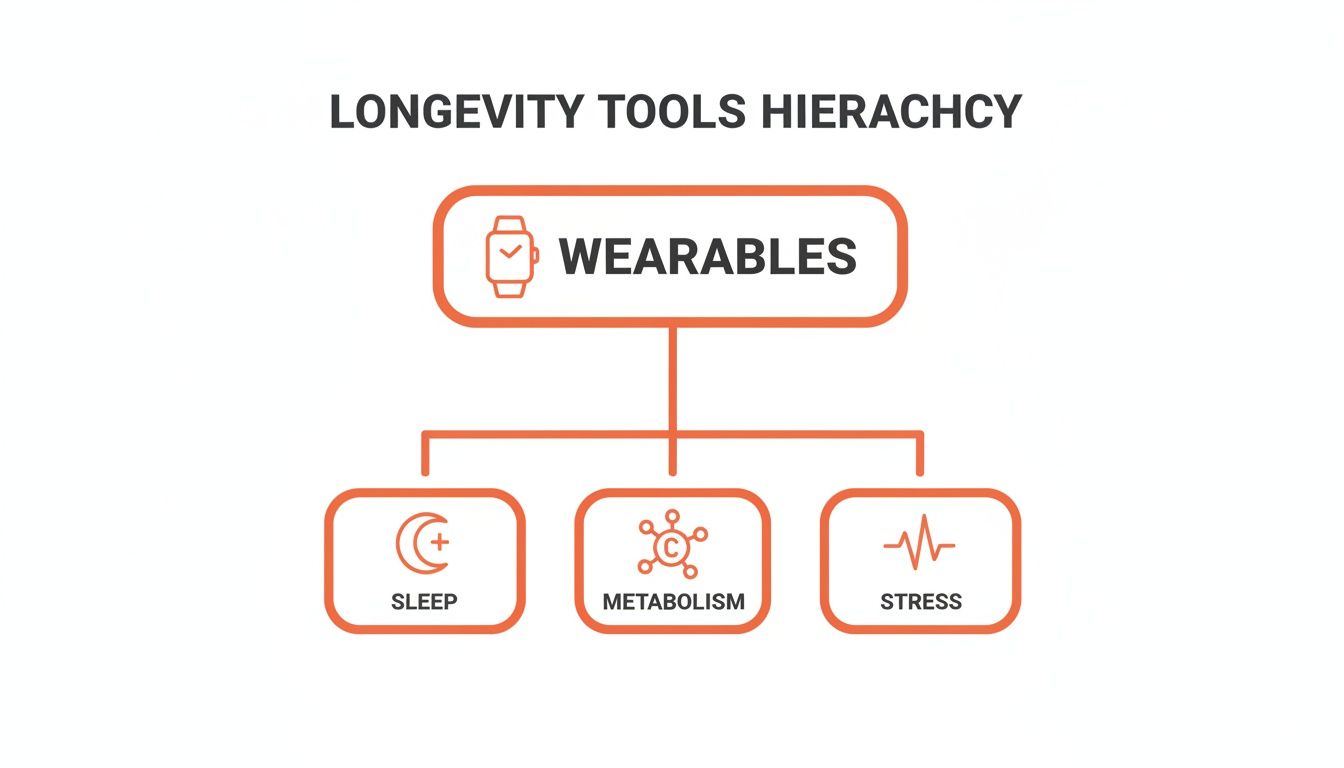
This kind of unified view is incredibly powerful because it shows you how these systems are all interconnected, giving you a much clearer picture of your overall health.
To truly understand what your wearable is telling you, it helps to know which signals matter most. Here’s a quick breakdown of the key biomarkers that have a direct impact on your healthspan.
Key Longevity Biomarkers Tracked by Wearables
Biomarker | What It Measures | Why It Matters for Longevity |
|---|---|---|
Heart Rate Variability (HRV) | The variation in time between consecutive heartbeats, reflecting nervous system balance. | A higher HRV indicates better stress resilience, recovery, and adaptability—key for managing chronic stress and aging well. |
Resting Heart Rate (RHR) | Your heart rate when you are completely at rest, typically measured overnight. | A lower RHR is a strong indicator of cardiovascular efficiency and fitness, linked to reduced risk of heart disease. |
Sleep Architecture | The breakdown of sleep into Light, Deep, and REM stages throughout the night. | Each stage is critical. Deep sleep is for physical repair, while REM is for cognitive function and memory consolidation. Poor sleep quality accelerates aging. |
Blood Oxygen (SpO2) | The percentage of oxygen in your blood. | Consistent, optimal SpO2 levels (typically 95% or higher) are vital for cellular energy and function. Drops can signal respiratory issues like sleep apnea. |
Skin Temperature | Fluctuations in your skin's surface temperature, often measured during sleep. | Deviations can be an early warning sign of impending illness, overtraining, or hormonal shifts. |
Having access to this data is like getting a daily report card from your body. It allows you to make adjustments before small issues turn into bigger problems.
Sleep and Metabolic Health
Beyond the heart metrics, sleep architecture is absolutely non-negotiable. It’s not about the total hours you're in bed; it's about the quality of your deep, REM, and light sleep. Each stage has a unique job, handling everything from locking in memories to cleaning up cellular waste. When I managed to increase my deep sleep, even by just a few minutes a night, the difference in my energy and focus the next day was undeniable.
Finally, while it’s not yet standard in most wearables, continuous glucose monitoring (CGM) completes the picture by giving you a real-time window into your metabolic health. Seeing exactly how your body reacts to a specific meal gives you an incredible amount of control over your energy levels and long-term metabolic function. For a comprehensive look at these metrics and others, you can learn about all the https://outlive.bio/biometrics we focus on in our programs.
How to Evaluate Wearable Accuracy and Data Ownership
A wearable is only as good as the sensors inside it. I can tell you from personal experience that acting on bad data is far worse than having no data at all. It sends you down the wrong path, leading to flawed conclusions and misguided health decisions. If you're serious about longevity, you need a way to cut through the marketing fluff and judge a device's true reliability.
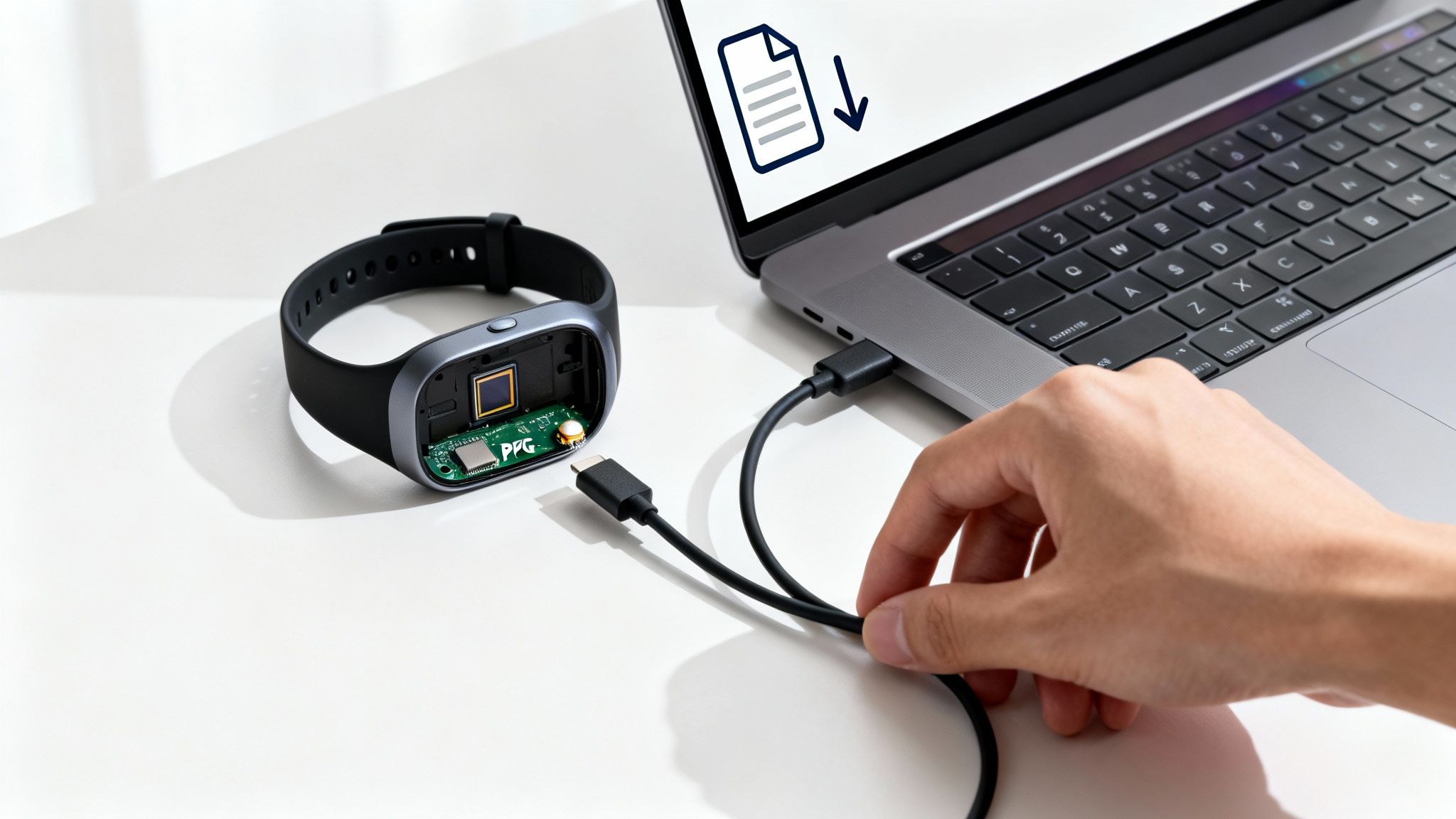
Most of these devices rely on a technology called photoplethysmography (PPG). It’s a fancy term for a simple process: an LED shines light onto your skin, and a sensor measures the light that bounces back to track changes in blood flow. This is the magic behind how they read your heart rate and HRV. Other key components, like accelerometers, track your every move to analyze activity levels and sleep patterns. While this technology is impressive, it definitely has its limitations.
Judging Sensor Reliability
First things first: look for independent validation studies. Any company worth its salt will have published research comparing its device against the gold standards used in clinical settings—think an electrocardiogram (ECG) for heart rate or a polysomnography (PSG) lab test for sleep. If they can't show you the proof, you’re essentially just trusting their marketing team.
Take sleep tracking. It’s absolutely critical for longevity, but not all trackers are created equal. Some have been shown in independent studies to be far more accurate at measuring total sleep time and differentiating between deep and light stages. While heart rate tracking on most top-tier wearables is now impressively accurate (often within 3% of lab equipment), other metrics can be way off. It's not uncommon for a device to overestimate something like VO2 max by as much as 15%. This is exactly why you have to prioritize devices that have been proven precise for the core longevity metrics you care about. You can discover more insights about wearable accuracy on Superage.
The Overlooked Importance of Data Ownership
Here’s something most people don’t think about until it’s too late: data ownership. The best wearable for longevity doesn't just collect your data; it gives you the keys to it.
Before you commit to a device, you need to ask a few pointed questions:
Can I easily export my raw data? You should be able to download your day-by-day metrics in a simple, usable format like a CSV file.
Does it integrate with third-party platforms? A device that plays well with others allows you to connect your data to specialized health apps for deeper analysis or to share it directly with your doctor.
What does the privacy policy actually say? You need to understand exactly how your health data is stored, who can use it, and how it’s protected.
Open platforms let you create a truly holistic picture of your health by combining your wearable data with other sources, like your latest blood work. In contrast, closed ecosystems hold your information hostage, severely limiting its value. Choosing a device that respects your right to own your data is a non-negotiable step in taking charge of your long-term health.
Translating Your Data Into a Clinical Action Plan
Collecting data with your wearable is just the starting line. The real magic happens when that firehose of information gets turned into a personalized, clinical action plan. I've seen it myself—the raw biometric signals from an Oura Ring or a Garmin can feel like a foreign language at first. The key is to translate those streams of heartbeats, temperature shifts, and sleep cycles into simple, actionable health scores and real-time guidance.
This is how abstract numbers start telling a clear story about your biology. Instead of just seeing a low HRV score and shrugging, you begin to understand it as a clear signal of accumulated stress. Suddenly, you can connect the dots between your daily habits—that late-night work session or an especially tough workout—and your body's actual recovery state.
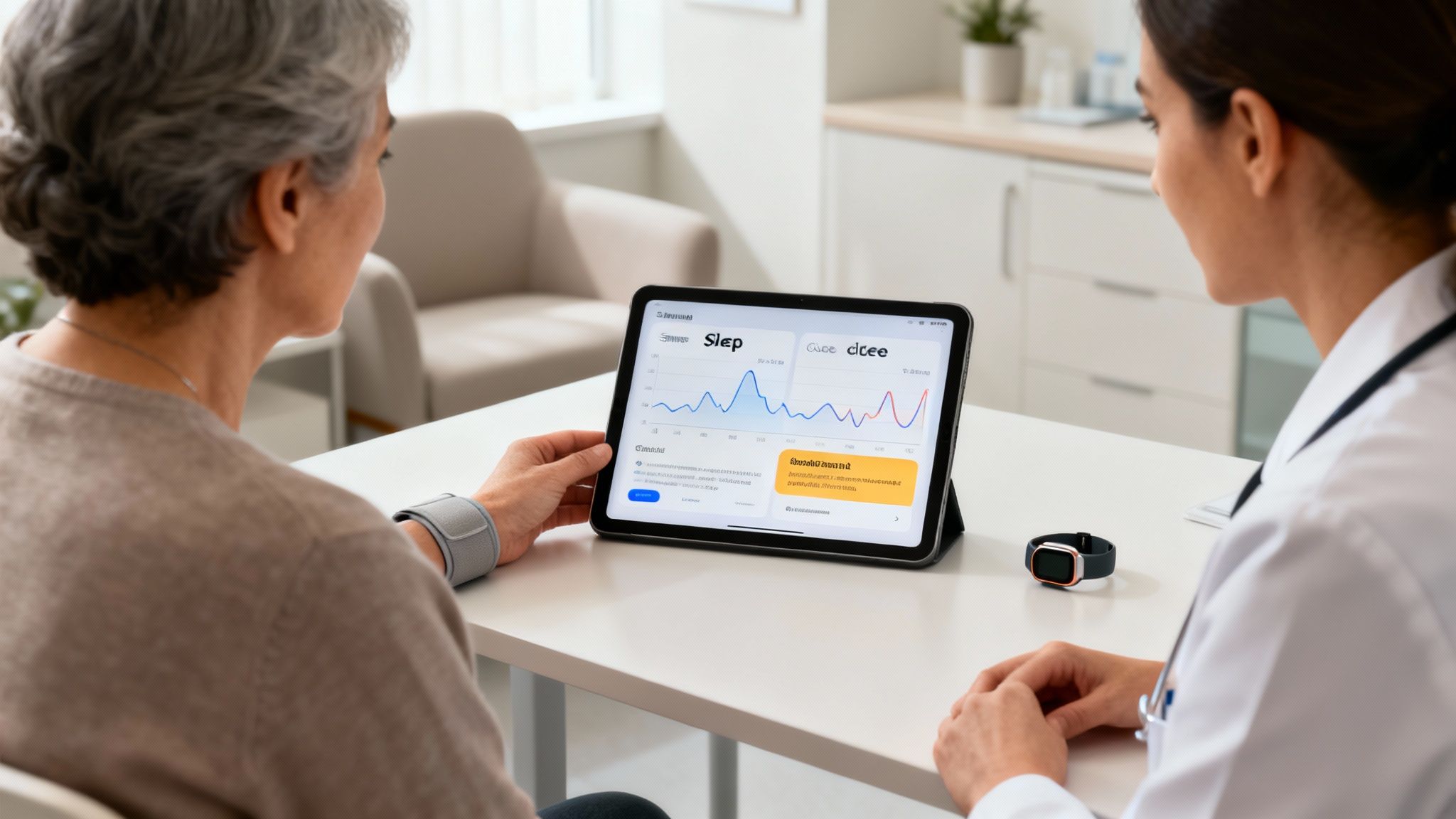
Bridging Wearable Data and Clinical Insights
Things get really powerful when we combine continuous monitoring from your wearable with periodic, comprehensive blood labs. Think of your wearable as the minute-by-minute reporter on the ground, while your blood work is the deep-dive intelligence briefing you get every quarter. Together, they create a 360-degree view of your health that neither could ever provide alone.
Imagine seeing precisely how your sleep scores from last night directly influence today's cortisol and glucose levels. This is where data-driven health becomes incredibly personal and, more importantly, effective. We can finally move beyond generic advice like "get more sleep" and start making highly specific, clinician-supervised interventions.
This is how we make precise adjustments to improve metabolic health and hormonal balance. To get a better sense of this, it helps to understand how we track the benefits of continuous glucose monitoring as one crucial piece of the complete health puzzle.
Creating an Evolving Health Strategy
This data-driven feedback loop means your health plan is never static; it evolves with your biology. As your wearable and lab data shift, your clinician can fine-tune your protocols. That might mean adjusting your nutrition, dialing back your training intensity, or optimizing a therapeutic intervention.
We know that smart wearables have a proven, significant impact on physical health in older adults. Their knack for motivating positive behaviors, like consistent exercise, is a huge part of improving health outcomes as we age. For anyone curious, you can read the full research about wearable effectiveness and its impact. This is precisely why choosing the best wearable for longevity is so critical—it’s the engine for your entire personalized health journey.
Matching a Wearable to Your Personal Health Goals
What's the biggest mistake I see people make when picking a wearable? They start by asking, "What's the best one?" without first asking themselves, "What do I actually want to do?"
There's no single "best" wearable for longevity. The right device is the one that fits your specific health goals. Think of it this way: you wouldn't use a hammer to turn a screw. In the same vein, the perfect tracker for an elite athlete isn't necessarily the best choice for someone trying to balance their hormones. Your personal biology and what you want to achieve should always be your starting point.
Defining Your Primary Objective
To find the right tool for the job, you have to be crystal clear on what that job is. Are you constantly exhausted and pretty sure your sleep is to blame? Are you an active person trying to push your limits without burning out? Or maybe you're navigating a specific life stage, like perimenopause, and need to get a handle on the subtle shifts happening in your body.
Let’s walk through a few common scenarios.
Goal: Sleep and Recovery Optimization. If your main priority is finally getting a good night's rest, you need a device built for detailed sleep analysis that you'll actually wear all night. This is where a ring, like the Oura, really shines. It's comfortable, unobtrusive, and its temperature sensing is top-notch—a critical metric for tracking true sleep quality.
Goal: Athletic Performance and Metabolic Output. For serious athletes or anyone deep into a training program, a wrist-based device from a company like Garmin or Whoop is often the way to go. These gadgets are fantastic at tracking workout intensity, overall training load, and recovery, giving you a clear picture of your body's strain and whether you're ready for the next big push.
Goal: Hormonal Balance and Metabolic Health. If you're focusing on your metabolism or managing hormonal fluctuations, your tracker needs to be excellent at monitoring two key signals: body temperature and Heart Rate Variability (HRV). When you look at these metrics alongside your lab work, you can start to see patterns tied directly to your menstrual cycle or how your body responds to food, stress, and exercise.
Discovering patterns in your metabolic data is the first step. The next is turning that insight into action. For instance, if your data shows metabolic inflexibility, learning how to implement strategies like intermittent fasting could be a powerful way to improve your metabolic health and, ultimately, your healthspan.
This isn't about picking a winner; it's about making an informed choice for your unique journey. For a more detailed breakdown of specific models, take a look at our suggested device list.
Choosing Your Wearable Based on Longevity Goals
To make this even clearer, let's put these ideas into a simple framework. The table below breaks down different health goals and matches them with the type of wearable and key features that will serve you best.
Primary Goal | Ideal Wearable Type | Key Features to Look For | Example Devices |
|---|---|---|---|
Sleep & Recovery | Ring or comfortable wristband | Continuous temperature sensing, accurate sleep staging (REM, Deep), HRV tracking. | Oura Ring, Whoop |
Athletic Performance | Sports watch or dedicated band | GPS, training load/strain metrics, VO2 max estimation, workout-specific modes. | Garmin Forerunner, Polar |
Metabolic Health | Ring, Patch, or Watch | Continuous Glucose Monitoring (CGM) integration, high-fidelity HRV and temperature. | Levels (with CGM), Oura Ring |
Hormonal Tracking | Ring or advanced watch | Highly sensitive temperature sensor, cycle tracking algorithms, reliable HRV. | Oura Ring, Apple Watch Series 8+ |
Ultimately, this table is a starting point. Your personal preferences for comfort, aesthetics, and app usability will also play a huge role. The goal is to find a device that gives you the data you need in a form you'll actually use consistently.
Frequently Asked Questions
Diving into health wearables can feel like learning a new language. I get it. As I've spent years digging into these devices for my own health, I've realized that the right answers are what separate a good investment from a gadget that just ends up in a drawer.
Let's walk through some of the most common questions I hear. My goal is to give you the clear, straightforward advice you need to make the right call for your own longevity journey.
Which Wearable Is Best for Sleep Tracking?
This is probably the number one question people ask, and from my perspective, the answer almost always comes down to two major players: the Oura Ring and the WHOOP band. The "best" choice isn't about which one is technically superior across the board, but about what fits your lifestyle and what data you care about most.
Oura Ring: The ring form factor is its killer feature. It's just so much more comfortable to sleep in than a wristband for many people. It's also fantastic at tracking body temperature, a crucial signal for analyzing sleep quality and, for women, understanding hormonal cycles.
WHOOP Band: If you're an athlete or highly active, WHOOP's focus on strain and recovery is hard to beat. It has been validated in independent studies for its impressive accuracy in sleep staging (distinguishing between deep, REM, and light sleep). It really shines when you want to see exactly how your sleep impacts your physical readiness for the next day.
Do I Need a Continuous Glucose Monitor Too?
If you're serious about your metabolic health, then in my opinion, adding a continuous glucose monitor (CGM) is a complete game-changer. Your Garmin or Fitbit gives you a great overview of activity and sleep, but a CGM opens a direct, real-time window into how your body is actually handling the fuel you give it.
Nothing drives a lesson home like seeing your own glucose spike after a certain meal. When you can see that data next to your sleep score from the night before, you start connecting the dots. You can literally see how a bad night's sleep tanks your glucose control the next day, or how a post-meal walk flattens the curve. It’s an essential tool for anyone focused on optimizing their metabolism.
How Can I Trust My Wearable's Data?
This is a fantastic and absolutely essential question. It starts with choosing a reputable brand—look for companies that are transparent about their accuracy and point to independent validation studies that test their sensors against clinical gold standards.
Don't get fixated on one weird data point. A single night of bad HRV might just be a fluke. But a two-week downward trend? That’s a real signal your body is sending you. The ultimate source of truth comes from combining that wearable data with how you actually feel and with objective clinical results, like your blood work. That’s how you build a complete and reliable picture of your health.
At Outlive Biology, we specialize in helping you make sense of it all. We don't just look at your wearable data in a vacuum; we integrate signals from devices like Oura, Whoop, and Garmin with your comprehensive lab results to create a clinician-guided action plan that's unique to you. If you're ready to turn all that data into meaningful health outcomes, learn more about our approach at https://outlive.bio.
Live better for longer.
Research-backed tools, tactics, and techniques to maximize your health, delivered to your inbox every Monday.
Because real transformation starts with trust
and trust starts with clarity.
Founding Member Discount
Includes Devices + Labs
Cancel Anytime Before Activation