Longevity

Last Updated
Jan 2, 2026
If you’re serious about slowing or even reversing the aging process, you need a plan—not just good intentions. Through my personal health journey and professional experience, I’ve found that the most powerful approach is a data-driven protocol. This means we measure key biological markers and then systematically improve them through personalized changes in nutrition, exercise, sleep, and if needed, targeted clinical therapies.
This isn’t about chasing a single miracle cure. It’s about making consistent, evidence-based adjustments that are tailored to your unique biochemistry. From a professional standpoint, the first, and most crucial, step is to figure out exactly where you stand right now.
Your Personal Journey to Reverse Aging Starts Here

The concept of turning back the clock has moved from the pages of science fiction into the realm of practical science. My journey has taught me that real progress in longevity isn't found in generic advice or the latest wellness fads. It’s found in a structured, measurable framework that treats your health like a system you can fine-tune and optimize.
This guide is designed to cut through all that noise. We’re not just going to talk about eating better or sleeping more. We will dive into the specific biomarkers that define your true biological age and lay out a clear plan to improve them. It all boils down to making sustainable, informed changes based on your own data.
Shifting From Guesswork to Precision
For years, I approached my own health with good intentions but very little real data. I'd try a new diet or a different workout routine, basically just hoping for the best. The real breakthrough came when I started consistently measuring my biological age and other key health markers. This data-driven perspective changed everything, turning vague goals into concrete, actionable targets.
This is the core philosophy we’ll build on throughout this guide:
Establish a Baseline: You can’t improve what you don’t measure. The first step is always to get a clear picture of your starting point with specific lab tests and vital signs.
Personalize Your Interventions: Your body is unique. What works wonders for someone else might not do much for you. Your personal data is what guides every decision.
Track and Adjust: Think of this as a continuous feedback loop. Monitoring your progress allows for smart adjustments to your protocol, ensuring you’re always on the right track.
This shift toward quantifiable health isn't just a niche interest anymore. The global anti-aging market is projected to skyrocket, potentially reaching over $162 billion by 2034. That growth is being driven by people like us who are deciding to take an active role in the aging process.
Building Your Data-Driven Protocol
Our goal here is to create a personal operating system for your health. To get started, you'll need to gather some baseline data. This initial assessment gives you the "before" picture, allowing you to track progress and see what's working.
Here’s a quick rundown of the essential data points you’ll want to collect.
Your Initial Anti-Aging Assessment Checklist
Assessment Category | Key Metrics to Track | Why It Matters |
|---|---|---|
Lab Work | Biological age test (e.g., DNA methylation), comprehensive blood panel (lipids, HbA1c, hs-CRP, hormones) | Provides a cellular-level snapshot of your aging process and identifies underlying inflammation or metabolic issues. |
Wearable Data | Heart Rate Variability (HRV), Resting Heart Rate (RHR), Sleep Stages (Deep, REM), Daily Steps/Activity | Offers real-time feedback on your nervous system balance, recovery, sleep quality, and overall activity levels. |
Vital Signs | Blood Pressure, Waist-to-Hip Ratio, Body Composition (DEXA or BIA scan) | Tracks cardiovascular health and visceral fat, which are critical indicators of metabolic health and longevity. |
This checklist is your starting point. It provides the objective data needed to move from guessing to knowing.
From here, we'll cover everything from foundational habits like nutrition and sleep to more advanced strategies, always with an eye on safety and personalization. You'll learn how to have informed, productive conversations with your doctor and make choices that truly align with your long-term health goals.
As you begin, it’s always a good idea to discuss your plan with a qualified healthcare professional. You can easily find physicians to book a medical consultation online who can provide personalized guidance. A data-driven approach doesn’t mean going it alone; it means using information to collaborate more effectively with your medical team.
Consider this guide your roadmap for building a practical, effective strategy to live a longer, healthier, and more vital life.
Measuring What Matters: Establishing Your Baseline
You can’t manage what you don’t measure. It’s a classic saying for a reason, and it’s especially true when it comes to longevity. Before we touch a single thing in your diet or daily routine, the first real step is getting an objective, data-driven snapshot of where your health truly stands.
This goes way beyond the number on your driver's license. We need to know your biological age—the true age of your body at the cellular level. This number reflects the cumulative wear and tear from your lifestyle, genetics, and environment. And unlike your chronological age, this is a number you can actually change. This is how we move from guesswork to a precise, scientific plan.
Key Lab Tests for Longevity
To really see what's going on under the hood, a standard physical isn't going to cut it. We need a targeted blood panel to get the raw data on your internal health. For anyone serious about this, I consider these tests completely non-negotiable.
First up is the epigenetic age clock. This is the gold standard for measuring your actual rate of aging. Tests like DunedinPACE look at the methylation patterns on your DNA to calculate how quickly your body is aging. A result below 1.0 means you're aging slower than the calendar; above 1.0 means you're aging faster. It's a sobering, but incredibly powerful, piece of data.
Next, we need a complete metabolic workup. This has to include:
HbA1c and Fasting Insulin: These two markers give us a clear picture of how your body manages blood sugar over the long term. If there's one thing we know for sure, it's that poor glucose control is a fast track to aging and chronic disease.
Advanced Lipid Panel: Forget the standard cholesterol tests your doctor usually runs; they're outdated. We need to measure ApoB, which tells you the total number of artery-clogging particles, and Lp(a), a nasty genetic risk factor for heart disease that most people never get tested for.
Inflammatory Markers: Chronic, low-grade inflammation is another pillar of the aging process. A high-sensitivity C-reactive protein (hs-CRP) test reveals the level of systemic inflammation simmering in your body.
Getting these specific labs done provides an incredible foundation. For a much deeper dive, our complete guide on the essential blood tests for longevity breaks down exactly what to ask your doctor for and why each marker is so critical.
Leveraging Wearable Technology for Daily Insights
Lab tests give us a crucial snapshot a few times a year, but your wearable gives you a continuous, real-time data stream. It’s the feedback loop that connects your daily choices to your biology.
From my own experience, this is what makes the protocol stick. Seeing my Heart Rate Variability (HRV) jump after a solid night's sleep or a 10-minute meditation session is immediate, tangible proof that what I'm doing is working.
Here are the vital signs you should be tracking with a device like an Oura Ring, Whoop, or Garmin:
Heart Rate Variability (HRV): This measures the tiny variations in time between your heartbeats. It's one of the best indicators of your nervous system's balance and your body's resilience to stress. Higher is almost always better.
Resting Heart Rate (RHR): A consistently lower RHR is a great sign of strong cardiovascular fitness and an efficient heart.
Sleep Quality: Don't just look at how many hours you were in bed. You need to know your sleep stages, especially deep sleep (for physical recovery) and REM sleep (for brain health and memory).
Creating Your Personal Health Dashboard
Okay, you’ve got your lab results and a firehose of data from your wearable. The final step is to pull it all into one place. This can be as simple as a spreadsheet you build yourself or a dedicated app. This dashboard becomes your mission control for tracking progress and seeing the real-world impact of your efforts.
This isn’t just about collecting numbers for the sake of it. It’s about spotting trends and connecting the dots. You’ll start to see how a stressful week tanks your HRV or how cutting out sugar brings down your fasting glucose. This personalized insight is what transforms a generic plan into your protocol.
This push for quantifiable health is happening on a global scale. The number of people aged 60 and older is projected to nearly double to 2.1 billion by 2050. This massive demographic shift is what's fueling so much innovation in the anti-aging field, as more of us look for ways to not just live longer, but live better. You can see more data on these global trends and what it means for the anti-aging market on Market.us.
By establishing this clear, data-rich baseline, you're setting the stage for a truly personalized and effective journey toward winding back your biological clock.
Building Your Foundational Longevity Protocol
Alright, with your baseline data in hand, it's time to get to work. This is where we build the core of your strategy to actually turn back the clock on aging. Forget about chasing exotic supplements or complicated biohacks for now. The most powerful and sustainable changes come from absolutely mastering the fundamentals.
From my own experience, I can tell you that getting these core habits right delivers 80% of the results. Think of it as the bedrock for everything else. Without a solid foundation, even the most advanced therapies won't move the needle much. We're going to zero in on four key areas: nutrition, exercise, stress management, and sleep.
Mastering Your Fuel for Longevity
What you eat is one of the most powerful levers you can pull. We’re not just talking about weight management here; the goal is to optimize your cellular energy, get a handle on inflammation, and preserve precious muscle mass as you get older.
Two principles have been game-changers for me. First is time-restricted eating (TRE), which most people know as intermittent fasting. By shrinking my eating window—usually to 8 hours (a 16:8 schedule)—I give my body a long daily break from digestion. This frees it up to focus on crucial cellular cleanup jobs, a process called autophagy, that gets rid of old, junky cells.
The second is making protein a priority. As we age, our bodies get less efficient at building and maintaining muscle, leading to a condition called sarcopenia. To fight this, I aim for at least 1.6 grams of protein per kilogram of body weight. This simple change does wonders for supporting muscle synthesis and keeping my metabolism humming.
An Exercise Blueprint for Anti-Aging
Your weekly workout plan needs to be more than just random gym sessions. It should be a strategic mix of different types of exercise, with each one targeting a specific aspect of aging. The aim is a well-rounded program that supercharges your cardiovascular health, mitochondrial function, and muscular strength.
This is where all that data you've been collecting comes into play. The feedback loop is simple: your foundational habits influence your daily tracking, which then shows up in your body vitals and, ultimately, your lab results.
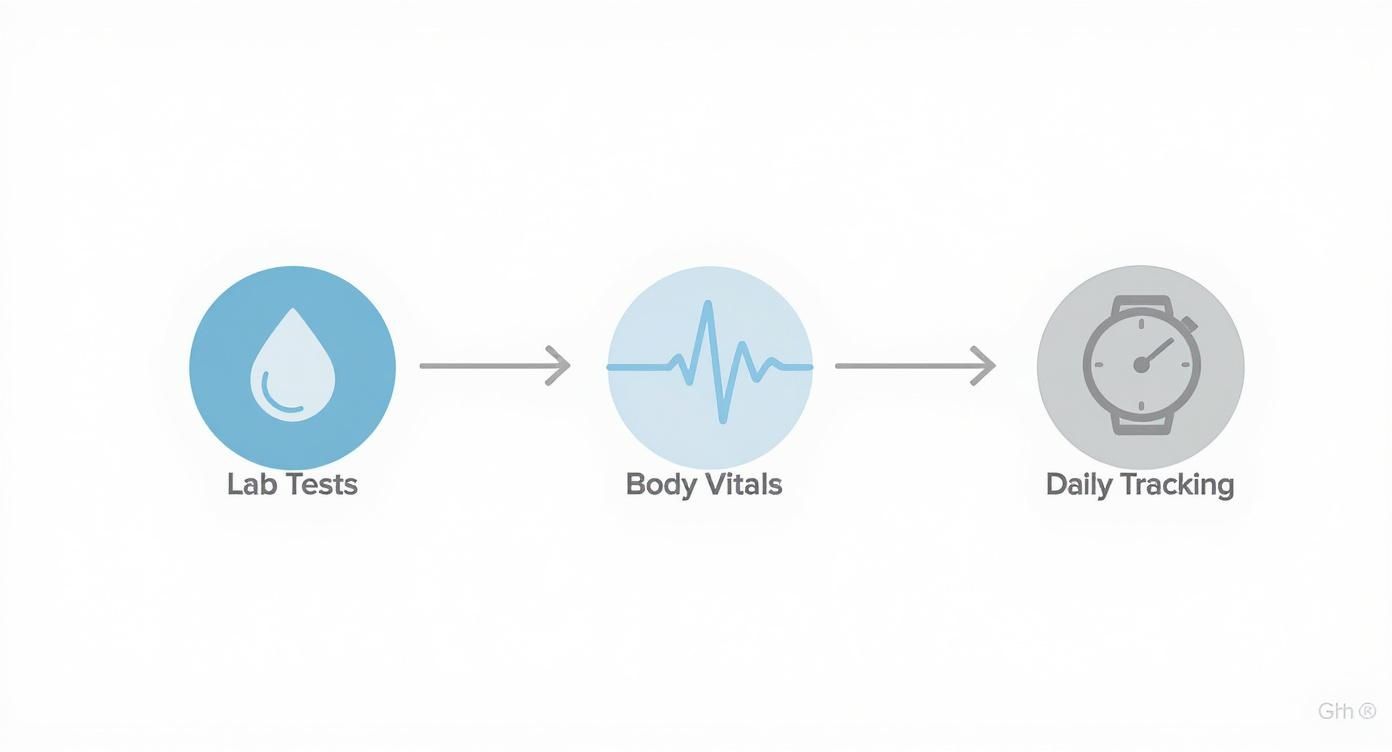
Here’s a quick breakdown of what a highly effective week can look like:
Zone 2 Cardio: This is that steady-state cardio where you can still hold a conversation. You'll want to log 150-180 minutes per week. This type of exercise is absolutely phenomenal for building mitochondrial density—you're literally upgrading your cellular power plants.
VO2 Max Training: This means short, all-out efforts that push your cardiovascular system to its absolute limit. Just one or two sessions a week, like doing 4x4-minute intervals, can make a huge difference in this key longevity marker.
Resistance Training: Lifting heavy things is non-negotiable. It's how you preserve muscle and bone density. Focus on big, compound movements like squats, deadlifts, and presses on at least two days a week.
To make this more tangible, here's a sample weekly schedule. This isn't a rigid prescription, but rather a template to show you how these different pieces can fit together seamlessly.
Weekly Longevity Exercise Protocol Example
Day | Primary Focus | Example Activity | Duration/Sets |
|---|---|---|---|
Monday | Resistance Training | Full Body Strength (Squats, Bench Press, Rows) | 3 sets of 6-8 reps |
Tuesday | Zone 2 Cardio | Incline Treadmill Walk or Zone 2 Cycling | 60 minutes |
Wednesday | VO2 Max Training | Airdyne Bike or Rower Intervals | 4 rounds of 4 min ON, 4 min OFF |
Thursday | Resistance Training | Full Body Strength (Deadlifts, Overhead Press) | 3 sets of 6-8 reps |
Friday | Zone 2 Cardio | Light Jog or Elliptical | 45 minutes |
Saturday | Active Recovery | Long Walk, Hike, or Mobility Work | 60+ minutes |
Sunday | Rest | Complete Rest or Gentle Stretching | N/A |
This balanced approach ensures you're hitting all the critical systems without overtraining any single one.
Managing Stress to Lower Biological Age
Chronic stress is a potent aging accelerator. It keeps your cortisol levels jacked up, dysregulates your nervous system, and fuels inflammation. The good news is, we can directly counter this with simple, daily practices that have a measurable effect on your biomarkers.
When I first started tracking my Heart Rate Variability (HRV), the connection became undeniable. A 10-minute morning meditation or a few rounds of box breathing would consistently bump up my HRV score. That’s a direct signal that my body was shifting from "fight-or-flight" into a "rest-and-digest" state.
These aren't just fluffy, feel-good exercises; they are direct inputs to your nervous system.
Meditation: Apps like Headspace or Waking Up offer fantastic guided sessions that can help lower cortisol and sharpen your focus.
Breathwork: Simple techniques like box breathing (inhale for 4 seconds, hold for 4, exhale for 4, hold for 4) can instantly calm your nervous system down.
As you build this protocol, don't forget that optimizing your brain is a critical part of the puzzle. For deeper insights into maintaining cognitive vitality as you age, it's worth exploring the best supplements for brain health.
The Restorative Power of Sleep
Finally, we have to talk about sleep—it’s hands down the most underrated performance and longevity tool out there. While you're sleeping, your body is hard at work clearing metabolic junk from your brain, repairing tissues, and locking in memories.
Consistent sleep hygiene is everything. You need a routine that reliably signals to your body that it's time to wind down.
Consistent Schedule: Try to go to bed and wake up at the same time every single day. Yes, even on weekends.
Cool, Dark, and Quiet: Turn your bedroom into a cave optimized for sleep.
Limit Blue Light: Step away from screens for at least an hour before bed. That blue light actively suppresses melatonin, the hormone that tells you it's time to sleep.
Mastering these four pillars—nutrition, exercise, stress, and sleep—creates a powerful synergistic effect. Each one reinforces the others, building a foundation of health that will slow, and in many cases, begin to reverse the aging process right down at the cellular level.
Stepping Up to Advanced Clinical Interventions
Once you've nailed the fundamentals—sleep, nutrition, exercise, and stress management—you might find yourself wondering, "What's the next level?" This is where we can get more targeted. It’s the point where you shift from building the foundation to fine-tuning your biology with advanced, clinically-guided interventions.
This isn't about blind supplementation or chasing quick fixes. It’s a methodical process of introducing powerful new variables, one at a time, so you can clearly see what moves the needle on your biomarkers. Let's be clear: these are serious tools that demand respect, your own research, and most importantly, medical supervision.
Fine-Tuning Your Metabolism and Cellular Energy
Your metabolic health is the engine of your longevity. If your glucose control is poor and insulin resistance is creeping in, you're on the fast track to accelerated aging. For some, even a perfect diet isn't enough to get those metabolic markers into the optimal range. That’s when it’s time to talk to your doctor about metabolic therapies.
Metformin is a great example. It's a long-standing, well-understood drug for type 2 diabetes that has caught the eye of the longevity community for its potential off-label uses. It works by making your body more sensitive to insulin and telling your liver to calm down on glucose production. It's no silver bullet, but for the right person with the lab data to back it up, it can be a strategic part of a broader anti-aging plan.
Beyond pharmaceuticals, we can also directly support our cellular power plants—the mitochondria. This is where therapies like red light therapy (photobiomodulation) come in. By using specific wavelengths of light, you can essentially give your mitochondria a boost. I've found that consistent use brings subtle but real improvements in my own energy and recovery, which I can often see reflected in better sleep and HRV scores on my wearable.
The Critical Role of Hormone Optimization
Hormones are the body's primary signaling network, and their natural decline is a well-known signpost of aging. Bringing hormone levels back into a healthy, youthful range can have a massive impact on everything from energy and body composition to mood and mental clarity for both men and women.
This brings us to Hormone Replacement Therapy (HRT) for women and Testosterone Replacement Therapy (TRT) for men. These can be truly life-altering, but only when a clinical deficiency has been diagnosed through proper blood work.
This is not a decision to make on a whim.
For Men: TRT can be a game-changer for restoring muscle mass, shoring up bone density, and reigniting libido and cognitive sharpness in men with clinically low testosterone. The trick is meticulous dosing and keeping a close eye on markers like hematocrit and estrogen to sidestep potential side effects.
For Women: HRT is incredibly effective for managing the challenging symptoms of perimenopause and menopause, and it offers proven protective benefits for bone and cardiovascular health. Any approach here has to be highly personalized, taking into account the specific hormones used and a woman's complete health history.
The New Frontier: Senolytics and Peptides
Looking ahead, some of the most fascinating research in aging is focused on clearing out cellular junk. As we get older, we accumulate "zombie cells," technically called senescent cells, that hang around and pump out inflammatory signals, damaging the healthy tissue around them.
Senolytics are a new class of compounds specifically designed to hunt down and destroy these senescent cells. While the field is still young, the science is incredibly promising. The concept is simple: by periodically clearing out this cellular debris, you can turn down systemic inflammation and bring your cellular environment back to a more youthful state. This area is exploding, with the global market for senolytics and similar drugs projected to hit around USD 8.72 billion by 2034. These treatments are a direct shot at a core mechanism of aging, and you can dig into the market trends at Precedence Research.
Peptides are another exciting avenue. These short amino acid chains act as precise signaling molecules. Depending on the peptide, they can help with tissue repair, enhance immune function, or even stimulate growth hormone release. But—and this is a big but—it's a complex and largely unregulated world. Getting the dosage right is absolutely critical for both safety and results, which is why using a tool like a dedicated peptide dosage calculator and working with a knowledgeable physician is non-negotiable.
Ultimately, navigating these advanced options is a partnership. Walk into your doctor's office armed with your data, a clear vision of your goals, and a commitment to tracking your progress. This is how you responsibly and safely use these powerful tools to push the boundaries of your healthspan.
Monitoring Progress and Adjusting Your Strategy
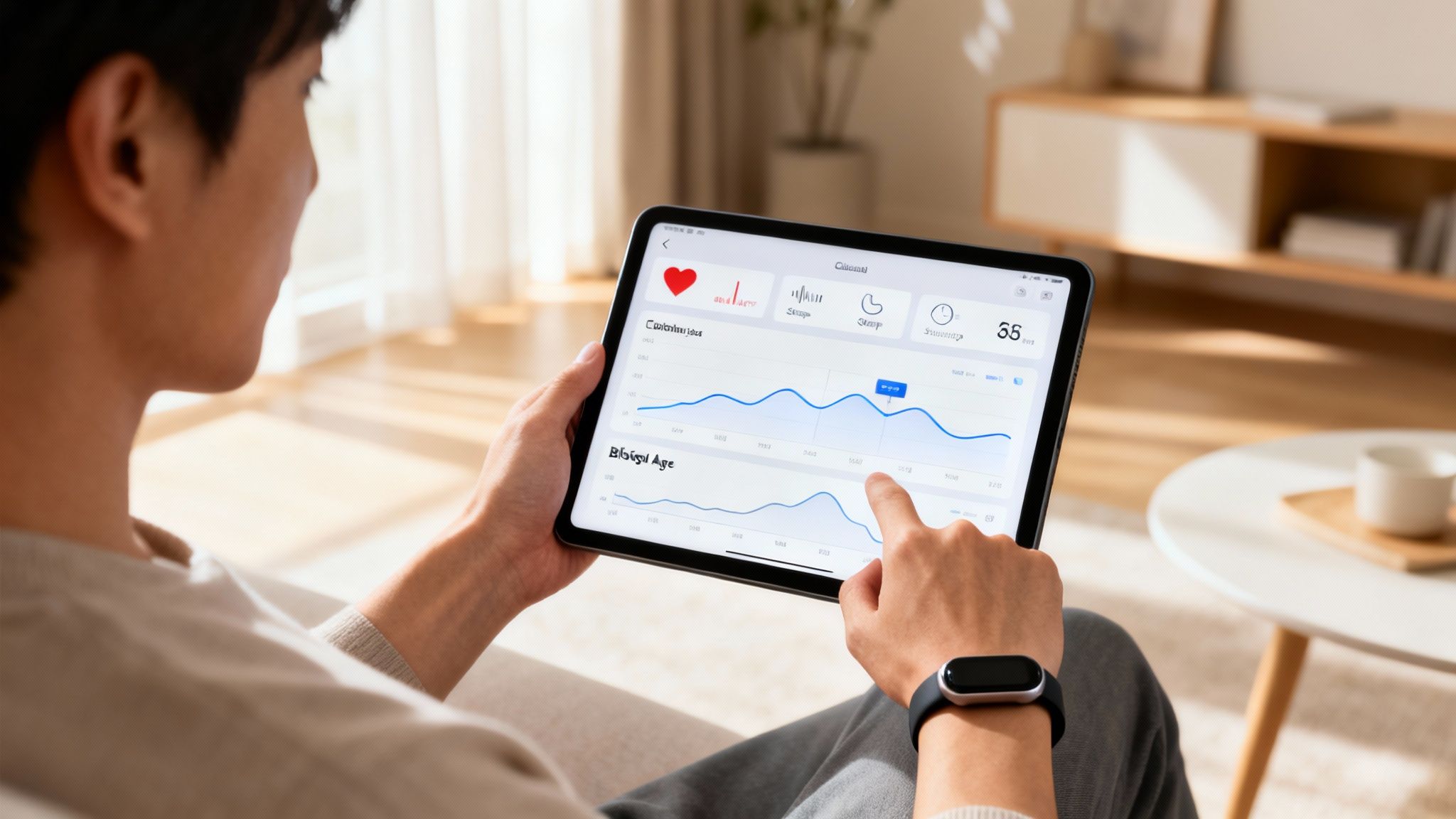
A plan to turn back your biological clock isn't something you set in stone. It’s a living, breathing system that has to adapt. The entire process hinges on a constant feedback loop: you make a change, you measure the result, and then you adjust your course based on what the data tells you.
This is where the real work—and the real progress—happens. It’s one thing to feel like you’re getting healthier, but it's something else entirely to see your hs-CRP plummet on a lab report after three months of cleaning up your diet. That objective proof is the most powerful motivator you can have.
This cycle of testing and tweaking ensures you’re not wasting time on things that don’t work for your unique biology. Instead, you're systematically refining your approach based on cold, hard evidence from your own body.
Establishing Your Testing Cadence
To build this feedback loop, you need a consistent schedule for re-testing. Without it, your data is just noise. A smart monitoring plan lets you see the whole picture, from daily fluctuations to long-term shifts.
This is the schedule I've found to be most effective:
Monthly Checks: Keep these simple and focused on immediate vitals. Use your home devices to track blood pressure and weight. This is frequent enough to spot any concerning trends early on without driving yourself crazy.
Quarterly Blood Tests: Every three months is the sweet spot for seeing meaningful changes in your bloodwork. This is when you'll re-check metrics like hs-CRP, HbA1c, and your lipid panel (especially ApoB). This gives your lifestyle changes enough time to actually make a measurable difference.
Annual Epigenetic Test: This is your final exam. An annual epigenetic age test, like the DunedinPACE test, is the ultimate report card. It tells you, at a cellular level, if you’re actually slowing or reversing your rate of aging over the long haul.
Interpreting Your Data and Making Smart Adjustments
Getting the numbers is just step one. The real skill is learning to read them and decide what to do next. When a marker isn’t moving in the right direction, it’s not a failure—it's a signal to dig deeper and adjust the plan.
Let’s walk through a couple of real-world scenarios.
Scenario 1: Your hs-CRP is Still High You’ve been eating clean for a full quarter, but your high-sensitivity C-reactive protein (a key inflammation marker) is still stubbornly high. Now what?
The Gut Reaction: "My diet isn't working."
The Data-Driven Response: "My current diet isn't working. What can I tweak?" Maybe this leads you to experiment with eliminating potential inflammatory triggers like gluten or dairy for the next 90 days. Or perhaps you double down on omega-3s from fatty fish to see if that moves the needle.
Scenario 2: Your HRV Isn't Improving Your Heart Rate Variability has been flat for a month, even though you’ve been meditating consistently.
The Gut Reaction: "Meditation is a waste of my time."
The Data-Driven Response: "Maybe the timing or type of my recovery work needs to change." You could try shifting your routine. Perhaps your nervous system responds better to a quiet evening walk, a different style of breathwork, or just a more rigid sleep-wake schedule.
This approach strips the emotion and guesswork out of the process. Every data point, good or bad, is just information. Use it to make a better decision for the next cycle. This is how you build a personalized, resilient, and truly effective protocol.
Answering Your Top Questions About Reversing Aging
As you start to connect these dots, questions are bound to surface. It’s one thing to understand the science; it’s another to actually live it day-to-day. Based on my own journey and countless conversations with people just starting out, a few questions tend to pop up again and again.
Let's get right into them. My goal is to clear up the practical hurdles that can slow you down, from feeling overwhelmed about where to begin to worrying about the cost and wondering when you'll actually see results.
If I Can Only Do One Thing, Where Should I Start?
If you're staring at all this information and feeling a bit overwhelmed, my advice is always the same: master your sleep. Hands down, it is the most powerful and restorative habit you can build. It costs you nothing but commitment, and its benefits cascade into every other part of your health.
Think about what happens when you get truly high-quality, consistent sleep:
Your hormones find their rhythm, especially those that manage hunger and stress.
Your brain gets a chance to perform its nightly cleanup, clearing out metabolic junk and sharpening your thinking.
Your body’s natural repair crews get to work, mending muscle and taming inflammation.
Before you spend a single dollar on fancy supplements or advanced lab tests, commit to 30 days of prioritizing sleep. I mean really commit. Same bedtime, same wake-up time. Make your bedroom a cold, dark cave. Power down screens an hour before bed. The changes you'll see in your energy, mood, and wearable data will create the perfect foundation for everything else to come.
How Can I Do This Without Breaking the Bank?
The longevity space often looks incredibly expensive, filled with high-tech gadgets and exclusive treatments. But here’s the truth: the most powerful strategies are either free or cost very little. You absolutely do not need a massive budget to make a real dent in your biological age.
Here’s how to get the biggest bang for your buck:
Nail the Free Fundamentals: We just covered sleep—that's free. So is getting morning sunlight, taking daily walks, and practicing simple breathwork to manage stress. These are the bedrock of health.
Eat Smart, Not Exotic: You don’t need rare superfoods flown in from across the globe. Just prioritizing high-quality protein while cutting out processed foods and sugar will deliver enormous metabolic wins.
Start with Basic Labs: A standard blood panel from your doctor can give you a treasure trove of data on glucose, lipids, and inflammation. It's often covered by insurance and provides a fantastic baseline before you even consider spending on more specialized tests.
What's a Realistic Timeline for Seeing Results?
Let's be clear: this is not a quick fix. Reversing biological age is a long game built on consistency. That said, you can expect to see and feel encouraging changes much sooner than you might think, which is a huge motivator to keep going.
From my experience, this is a pretty realistic timeline:
1–3 Months: You'll likely feel the difference first. More energy, better sleep scores on your wearable device, and sharper focus are common early wins. Your quarterly blood work might even show some initial progress, with slight improvements in inflammatory markers like hs-CRP or your fasting glucose.
6–12 Months: This is when the objective data really starts to shift. You should see meaningful improvements in your lipid panel (especially ApoB) and key metabolic markers like HbA1c. You'll also likely notice visible changes in your body composition.
12+ Months: After a solid year of consistent effort, re-testing your epigenetic age is the ultimate report card. It is entirely possible to see you've actually reversed your biological age or, at the very least, dramatically slowed your pace of aging.
The whole game is about patience and watching the trends move in the right direction. Don't get discouraged by a single off-day or a weird data point.
Live better for longer.
Research-backed tools, tactics, and techniques to maximize your health, delivered to your inbox every Monday.
Because real transformation starts with trust
and trust starts with clarity.
Founding Member Discount
Includes Devices + Labs
Cancel Anytime Before Activation