Health Tech

Last Updated
Jan 2, 2026
Are Smart Scales Accurate for Body Fat and Weight?
When it comes to tracking our health, many of us turn to smart scales for daily insights. The big question I often get is, "Are smart scales actually accurate?" From my personal and professional experience in health data analysis, the answer is nuanced.
For tracking your daily weight, they are remarkably precise. However, for body composition metrics like body fat or muscle mass, it's best to view them as tools for tracking long-term trends rather than providing a single, medically precise number. Understanding this distinction is the key to using a smart scale effectively on your health journey.
Decoding Smart Scale Accuracy
As someone who's been deeply involved in personal health data for years, I've seen firsthand what smart scales can and can't do. The immediate feedback is motivating, but you have to know what the numbers really mean to use them well. It's not about fixating on today's body fat percentage; it’s about watching the pattern emerge over weeks and months. That’s where the real insights are.
The true power of a smart scale is its consistency. For measuring your total body weight, these devices are incredibly reliable. A key 2021 study, which you can read more about in these findings on smart scale weight accuracy, pitted popular consumer scales against clinical-grade equipment. The result? The error margin for weight was often less than a pound. That makes them a fantastic tool for monitoring your day-to-day progress.
Weight vs. Body Composition: It's Not the Same Thing
It’s critical to understand the two very different jobs your smart scale is trying to do:
Measuring Weight: This is a direct measurement. The scale uses high-quality load sensors to determine your total mass, and it does this with a high degree of accuracy. It's simple, direct, and trustworthy.
Analyzing Body Composition: This is an estimation. The scale sends a tiny, imperceptible electrical current through your body—a technology called Bioelectrical Impedance Analysis (BIA)—to essentially guess what that weight is made of. This process is easily thrown off by things like your hydration level, when you last ate, or if you just worked out.
To give you a clearer picture, here's a quick rundown of how accurate you can expect these different metrics to be.
Smart Scale Accuracy at a Glance
Health Metric | Accuracy Level | Best Use Case |
|---|---|---|
Weight | Very High | Daily progress tracking and monitoring overall mass changes. |
Body Fat % | Moderate to Low | Tracking long-term trends (up or down) over months. |
Muscle Mass | Moderate to Low | Identifying general trends in muscle gain or loss. |
Bone Mass | Very Low | Not reliable for clinical use; view as a very rough estimate. |
Body Water % | Moderate | Gauging daily hydration fluctuations. |
This table helps illustrate why you can trust the weight reading but should take the body composition numbers with a grain of salt.
Getting this distinction right is the key to making the scale a useful part of your health toolkit. For example, in our work at Outlive Biology, we use these daily weigh-ins to complement the more precise, lab-based clinical data we collect. This helps our members see the full picture of their personal biometrics and connect the dots between their daily habits and long-term health.
How Smart Scales Estimate Your Body Composition
Ever step on a smart scale and wonder how it could possibly know your body fat percentage? It seems a little like magic, but the science behind it is actually pretty clever and surprisingly simple. These devices use a technology called Bioelectrical Impedance Analysis, or BIA, to get an inside look at what your total weight is made of.
From my own health journey, figuring this out was a real turning point. It helped me stop seeing the numbers as absolute truth and start using them as helpful signposts. Once you understand how BIA works, you’ll have a much better feel for what that morning weigh-in is actually telling you.
The Science of Bioelectrical Impedance Analysis
At its heart, BIA sends a tiny, completely harmless electrical current through your body. The signal usually goes up one foot, across your pelvis, and down the other. You won’t feel a thing—the current is that gentle.
The real secret here is water. Your body’s different tissues hold different amounts of water, which changes how easily that electrical signal can travel through them.
Muscle, blood, and organs are packed with water, making them great conductors. The signal zips right through with very little resistance.
Fat tissue, on the other hand, contains very little water. It acts more like an insulator, resisting the electrical current and slowing the signal down.
The scale measures the speed of this signal, or more specifically, its resistance. This resistance is called impedance. The higher the impedance, the more resistance the signal encountered, which suggests a higher percentage of body fat. Lower impedance, naturally, points to more lean mass.
From Electrical Signal to Body Composition Metrics
Getting that impedance reading is only the first part of the job. To turn that raw electrical data into the percentages you see on your app—body fat, muscle mass, bone density—the scale relies on a predictive algorithm.
This is where your personal stats come in. The algorithm takes your impedance measurement and combines it with the information you entered during setup, which is why it's so important to get those details right.
For instance, the formulas account for known physiological differences between people. Men and women tend to store fat in different patterns, and our bone density changes as we age. By factoring these variables in, the scale refines its guess to give you a more personalized—though still estimated—reading.
This diagram shows how smart scales handle the two main types of data they collect: direct measurement and algorithmic estimation.
As you can see, your weight is a direct, highly accurate measurement. The body fat percentage, however, is an estimate best used for tracking the direction of your progress over time, not as a standalone, perfect number.
Why Smart Scales Excel at Tracking Your Weight
When it comes to the simple, crucial task of measuring body weight, smart scales are incredibly consistent and reliable. They’re equipped with high-precision sensors, and for this one metric, their accuracy often rivals the calibrated scales you’d find in a doctor's office. In my experience, having that daily, dependable feedback is a cornerstone of any effective health plan.
This consistency is what makes them so powerful. You can see the immediate impact of your lifestyle choices—like how a salty meal affects you or what a great night's sleep does for your numbers. This kind of frequent tracking is essential for learning your body's unique patterns and making informed decisions.
The Power of Consistent Weigh-Ins
The real magic of a smart scale isn't in a single measurement, but in the rich story told by hundreds of them over time. Daily fluctuations are completely normal, but the trend line that emerges over weeks and months is where the real insight lies. This is where smart scales truly pull ahead of infrequent, less convenient weigh-ins.
This ability to capture data so frequently is highly reliable for tracking progress. Research backs this up, showing a strong link between smart scale weights and self-reported values. In fact, more frequent self-weighing—something smart scales make effortless—is linked to more significant weight loss. This really highlights their value for anyone focused on their metabolic health. You can dig into the research on frequent self-weighing if you're interested.
This consistent stream of data is also incredibly motivating. Seeing a downward trend, even with its daily ups and downs, provides the positive reinforcement needed to stick with new habits.
Making Your Data Actionable
Of course, tracking your weight is only half the battle. The data becomes much more powerful when you pair it with a solid plan. While a smart scale is fantastic at tracking your progress, that information is most effective when combined with effective weight loss tips to guide your health journey. Actionable strategies give your data purpose.
Here’s how consistent tracking helps you build a better health strategy:
Identify Patterns: You can easily spot how certain foods, workouts, or sleep patterns affect your weight.
Stay Accountable: The simple act of stepping on the scale daily creates a routine that reinforces your commitment.
Make Timely Adjustments: If your weight trends in the wrong direction for a week, you can quickly assess your habits and make changes before it becomes a bigger issue.
Ultimately, the accuracy and ease of use for weight measurement make smart scales an indispensable tool. They provide the reliable, high-frequency feedback necessary for anyone serious about monitoring their metabolic health and achieving long-term goals.
How Accurate Is the Body Fat Reading, Really?
Alright, let's get to the million-dollar question: Can you actually trust the body fat percentage your smart scale gives you? While the Bioelectrical Impedance Analysis (BIA) technology is clever, the reality is that body fat readings are incredibly sensitive to a whole host of factors.
This is the part of the journey where I’ve learned that a little nuance goes a long way. Instead of getting hung up on a single number as gospel, the real value is in tracking the trend over time. Daily ups and downs in your readings aren't just normal—they're completely expected.
What Throws Off Your Body Fat Reading?
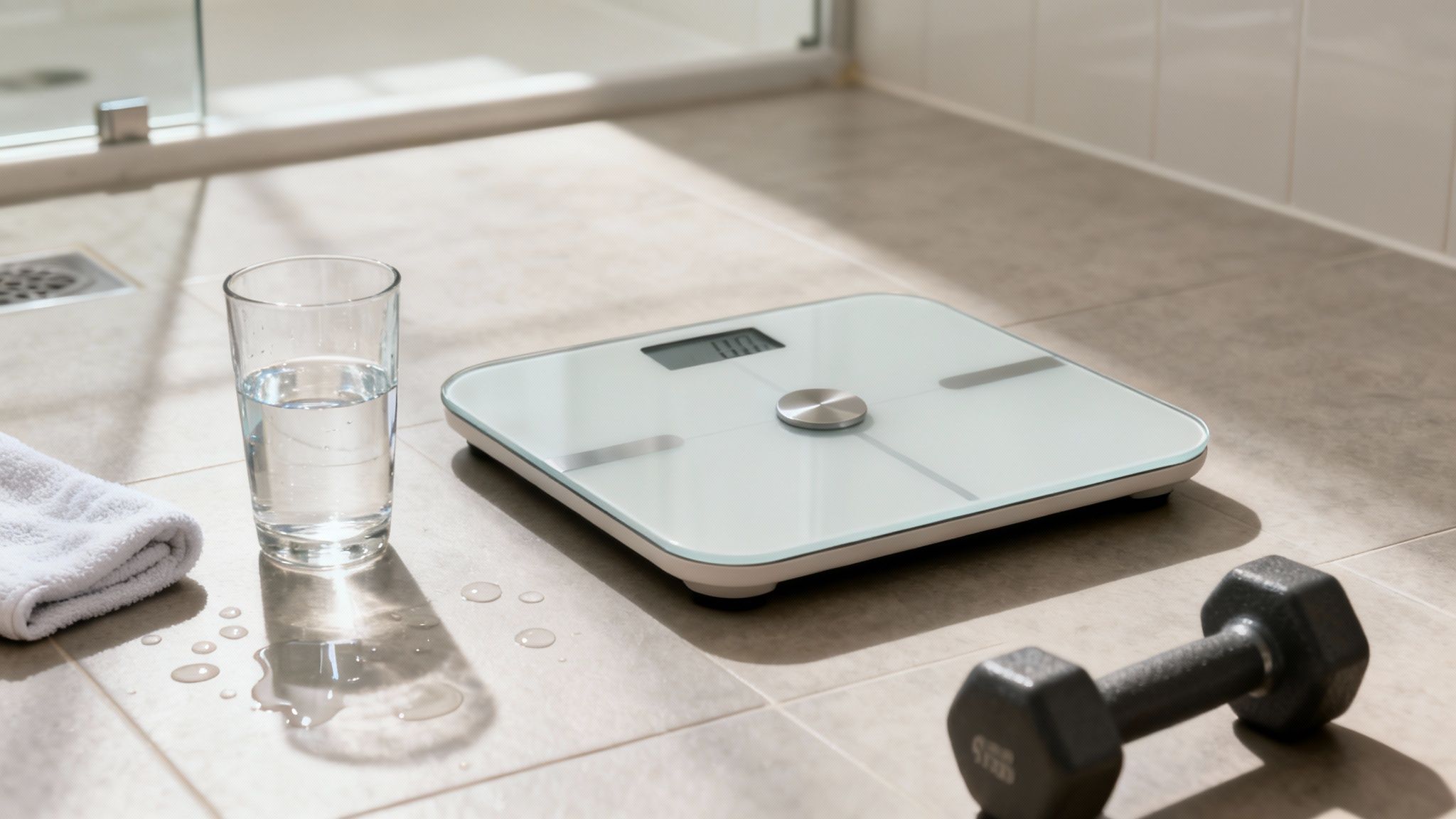
Think of your body as a dynamic, fluid system—because it is. BIA works by measuring how easily a tiny electrical current passes through your body, and that ease is almost entirely dependent on water content. So, anything that changes your hydration level will immediately change the scale's body fat calculation.
This is exactly why one-off measurements can be so deceptive. A reading taken right after a sweaty run is going to look wildly different from one you take first thing in the morning.
Here are the biggest culprits that can mess with your body fat number:
Hydration Levels: This is the big one. If you're dehydrated, your muscle tissue has less water, which makes it harder for the electrical signal to pass through. This increased resistance (impedance) fools the scale into thinking you have more fat than you actually do.
Recent Exercise: A tough workout can cause dehydration and temporarily shift fluids around your body. Both of these things can lead to a falsely high body fat reading. It's always best to wait a few hours after a workout before you step on the scale.
When You Last Ate and Drank: Chugging a big glass of water or eating a meal adds physical weight and can temporarily change your body’s conductivity. For the most consistent results, always try to weigh yourself before you've had anything to eat or drink.
Time of Day: Your body's hydration and fluid balance naturally change from morning to night. This is precisely why a consistent morning weigh-in routine is the key to collecting reliable data you can actually use to track trends.
Once you understand these variables, you can start to put the daily numbers in context. The goal isn't to chase a "perfect" number every single day. It's to control these factors as much as possible so the underlying trend can shine through.
Why Trends Beat Single Numbers, Every Time
Professionally speaking, the true power of a smart scale isn't its ability to give you a lab-accurate diagnostic number. It's in providing a steady stream of data points that reveal a trend. Watching your body fat percentage slowly but surely tick downward over several weeks is an incredibly powerful motivator. This holds true even if any individual number isn't perfectly aligned with a clinical DEXA scan—the gold standard for body composition analysis.
This is where we find the real answer to the accuracy question. For a single body fat measurement, their accuracy is quite limited. Research backs this up, consistently showing that consumer-grade BIA scales often disagree with DEXA scans. In fact, a significant 2021 study revealed that some devices had median errors for fat mass as high as -20.7%. You can dig into the specifics of these findings on body composition accuracy if you're curious.
The takeaway here is crucial: a smart scale is a fantastic tool for tracking your progress, but you shouldn't rely on it for a single, definitive measurement of your body fat.
Shifting Your Mindset for Success
Once you truly embrace this "trends over numbers" mindset, the scale transforms from a source of stress into a genuinely useful tool. You’ll stop panicking about a small jump after a salty meal and start focusing on the big picture.
Here’s how to reframe your approach:
Look for the Weekly Average: Don't obsess over today's number. Instead, check your average body fat percentage for the week. Is it lower than last week's average? That's a win.
Celebrate the Direction: If your goal is fat loss and your trend line is pointing down, you're succeeding. The exact number on the screen is far less important than that consistent, downward trajectory.
Use It as a Feedback Tool: Did your body fat percentage spike? Step back and think about what might have caused it. A change in diet? A particularly hard workout? Dehydration? Use the data as a clue to learn more about how your body responds.
By focusing on these long-term patterns, your smart scale becomes an effective partner in your health strategy, giving you the consistent feedback you need to stay motivated and make smart adjustments along the way.
How to Get the Most Reliable Data From Your Scale
So, we've established that smart scales are best for spotting long-term trends, not for delivering a single, perfect snapshot. But that doesn't mean you can't improve the quality of those trends. In my own experience, the single biggest difference-maker is creating a simple, consistent routine.
When you control the variables, you get cleaner, more meaningful data. This small effort turns your scale from a neat gadget into a genuinely effective tool for tracking your health over the long haul. It's not about chasing perfection with every weigh-in; it's about building a reliable process.
Create a Standardized Weigh-In Protocol
The secret to trustworthy BIA measurements is a standardized protocol—which is just a fancy way of saying "do the same thing, at the same time, every time." Things like your hydration level, what you just ate, and whether you've exercised can all throw off a BIA reading. Research has even confirmed just how much these factors matter.
By locking in your routine, you minimize that day-to-day "noise" and get a much clearer picture of your actual progress. Think of it like a science experiment: you’re trying to control all the variables so you can isolate the one thing you actually want to measure.
Your Morning Weigh-In Checklist
To get the most consistent readings, I recommend building this simple checklist into your morning routine.
Same Time, Every Day: Make it the first thing you do when you wake up. Your body’s fluid levels fluctuate throughout the day, so a consistent time helps establish a reliable baseline.
After Using the Restroom: This one’s a no-brainer. Always empty your bladder before stepping on the scale to remove a major variable that affects both total weight and BIA.
Before Eating or Drinking Anything: Weigh yourself while you're still in a fasted state—before that morning coffee or breakfast. Food and liquids add weight and can temporarily change your body's conductivity.
Minimal Clothing (Or None): For maximum consistency, either wear the exact same thing every time or just weigh yourself naked.
Optimizing Your Scale's Physical Setup
It’s not just when you weigh yourself that matters, but how and where. An unstable surface or fidgeting feet can easily throw off the sensors and corrupt your data.
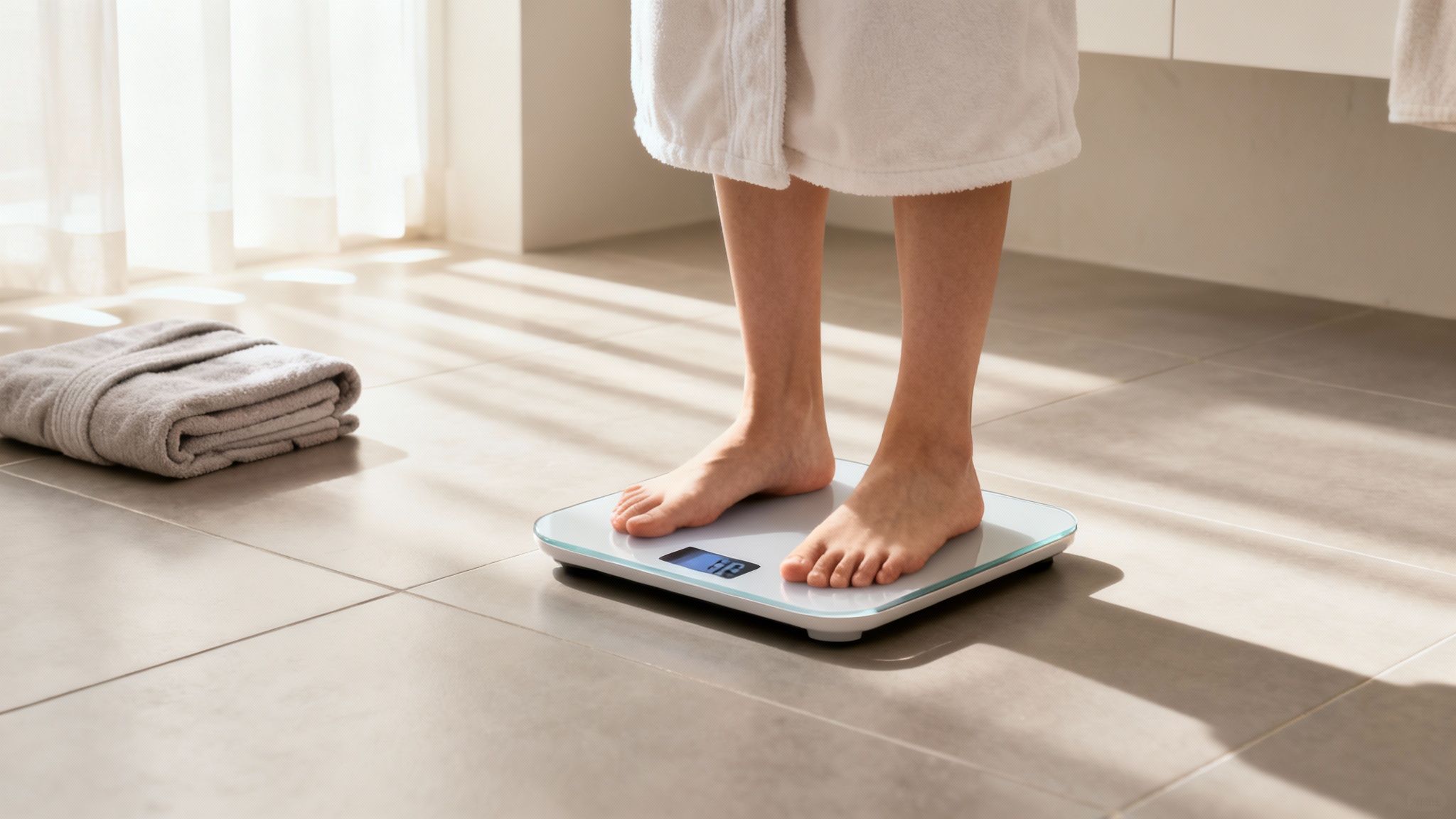
Use a Hard, Flat Surface: This is critical. Always place your scale on a solid, level floor like tile or hardwood. Carpet is a definite no-go, as it will cause inaccurate readings.
Stand Still and Balanced: Plant your feet firmly and evenly on the metal sensor pads. Try to stand as still as you can until the measurement is complete, because shifting your weight can interfere with the reading.
Use Bare, Dry Feet: For the BIA to work at all, your skin needs direct contact with the scale’s electrodes. Make sure your feet are clean and dry, since excess moisture can affect the electrical signal.
Nailing down this simple routine will dramatically improve the consistency of your data. And if you’re in the market for a new device that fits into this system, we’ve put together a curated list of our team's favorite tools in our suggested device list guide.
Combining Scale Data With a Holistic Health View
A smart scale is a fantastic tool for getting daily feedback, but its true power shines when you treat it as just one piece of a much larger health puzzle. Speaking from experience, the high-frequency data from your scale—like daily weight trends—becomes infinitely more useful when you pair it with less frequent, but more precise, clinical insights like blood work. This combination is how you build a complete picture of your health, moving beyond simple numbers to real, actionable intelligence.
Imagine this: your smart scale shows a steady downward trend in your estimated muscle mass over a few weeks. By itself, that’s a bit alarming. But what if you layer that information over recent blood work that shows your protein levels are low? Suddenly, the two data points tell a clear, connected story. This synergy between at-home data and clinical results allows you or your health coach to make targeted, effective changes, like tweaking your diet or workout routine.
Beyond the Scale: Your Health Data Ecosystem
Your smart scale doesn't exist in a vacuum. It’s just one of several data streams that help you understand your body. When you start connecting these dots, you create a powerful feedback loop that drives genuine progress. Your health ecosystem should ideally include multiple layers of information, each offering a different perspective.
Here are the key components to integrate with your scale's data:
Clinical Blood Labs: This is your ground truth. Periodic blood work gives you a precise look at internal health markers like hormones, inflammation, cholesterol, and nutrient levels that a scale can't even begin to guess at.
Wearable Technology: Devices that track sleep quality, heart rate variability (HRV), and daily activity add crucial context. For example, you can see if a night of poor sleep correlates with a next-day weight spike from water retention. To learn more, check out our guide on the best wearable for longevity.
Subjective Feelings: Never, ever discount how you feel. Logging your energy levels, mood, and stress can reveal patterns your devices might miss. If the numbers on the scale are improving but you feel completely drained, that’s a vital signal to pay attention to.
By weaving these sources together, you move from just tracking data to truly understanding your body's unique operating system.
Turning Data Into a Cohesive Strategy
Once you start collecting this information, the next step is putting it all together into a smart strategy. To get the most out of your smart scale’s body composition data, for instance, it helps to apply that information to a solid nutritional framework, like understanding macronutrients for weight loss. Your scale might show your body fat trend is heading down, but your knowledge of nutrition is what helps ensure you’re losing fat, not muscle.
This hybrid approach—combining frequent self-monitoring with periodic clinical check-ins—is fast becoming a cornerstone of modern personalized health. A 2022 review pointed out that this integration allows for more precise and personalized interventions, helping to bridge the gap between our daily habits and long-term health outcomes.
Ultimately, your smart scale is a starting point, not the final destination. By placing its data within this broader context, you transform it from a simple gadget into a vital component of a comprehensive and deeply personal wellness plan.
Common Questions About Smart Scales
Navigating the world of smart scales can bring up a lot of questions. I get it. From my own health journey and years of experience, I know it helps to have clear, direct answers. Let's tackle some of the most common questions I hear so you can use your scale with confidence.
Can My Smart Scale Be Wrong About Body Fat?
In a word, yes. A single body fat reading can definitely be off, especially when you compare it to a gold-standard clinical scan like a DEXA. The BIA technology in smart scales is super sensitive to things that change day-to-day, like your hydration levels, whether you just worked out, or what you recently ate or drank.
But here’s the secret: the real value isn’t in that one, isolated number. It's all about the trend over weeks and months. If your goal is to lose fat and your weekly average is consistently ticking down, you are absolutely winning, regardless of the daily noise.
Are More Expensive Smart Scales More Accurate?
Not necessarily, at least not when it comes to body composition. A pricier scale might give you a better build quality, a slicker app, or a few more bells and whistles, but the BIA technology underneath it all has pretty much the same limitations across the board. A higher price tag just doesn't guarantee a more accurate body fat percentage.
When it comes to measuring your weight, however, most reputable scales are already very accurate. My advice? Stick with a trusted brand that has the features you'll actually use, and don't assume that spending more will magically improve the BIA precision.
How Do Smart Scales Measure Bone Mass?
Smart scales estimate your bone mass using the same BIA technology they use for everything else. Their algorithm makes a calculation based on how the electrical signal passes through bone tissue versus your other tissues.
Honestly, just like the other body composition metrics, this number should be taken with a grain of salt. Bone mass changes incredibly slowly over time, so this feature is, at best, a way to spot very long-term trends. It's absolutely not a substitute for a real medical assessment.
Should I Use a Smart Scale If I Have a Pacemaker?
No, you absolutely should not. Nearly every manufacturer states this clearly: if you have a pacemaker, an implantable cardioverter-defibrillator (ICD), or any other internal electronic medical device, you should not use a BIA-enabled smart scale.
The very low-level electrical current the scale sends through your body could potentially interfere with your device's function. Your safety is what matters most, so always follow the manufacturer’s guidelines and check with your doctor before even considering a BIA device.
At Outlive Biology, we don’t just look at one data point. We integrate the trends from your smart scale with clinical insights from blood labs and wearable technology to build a complete, 360-degree picture of your health. We help you move beyond the guesswork, turning all that personal data into a clear, actionable plan for your metabolic health and longevity goals.
Learn how Outlive Biology can help you interpret your health data
Live better for longer.
Research-backed tools, tactics, and techniques to maximize your health, delivered to your inbox every Monday.
Because real transformation starts with trust
and trust starts with clarity.
Founding Member Discount
Includes Devices + Labs
Cancel Anytime Before Activation