Longevity

Last Updated
Jan 2, 2026
Finding Your Best Age to Retire Isn't About Money—It's About Your Health
When I started thinking about retirement, the first thing that came to my mind was a number—a dollar amount. For most of my life, I believed that the best age to retire was simply whenever my savings hit that magic figure. But a personal health scare a few years ago completely changed my perspective. I realized that the real goal isn't just to retire from a job, but to retire to a life full of energy and vitality.
The question isn't just about financial readiness anymore. The most critical question is: will you have the health to enjoy the freedom you've worked so hard to build? This guide is about shifting that focus from mere lifespan to your healthspan—the years you spend in good, active health—and using your own biology as a roadmap.
Rethinking When to Retire

We’ve been conditioned to see retirement as a financial finish line, usually set somewhere around age 65. But what if we've been looking at it all wrong? What if the most important variable isn't the size of your bank account, but the state of your biology?
From personal experience, I can tell you that planning for the future feels a lot less abstract when you put your health at the center of the conversation. The goal isn't just to reach retirement; it's to arrive there vibrant, healthy, and ready for your next chapter. This requires a crucial shift in focus from mere lifespan—how many years you live—to your healthspan.
This perspective flips the script entirely, prompting a far more important question: "What is the best age to retire for my body?" We're going to dig into a data-driven framework that uses personal health insights to map out a timeline that truly aligns with your vitality. For some, this might even open up the possibility of retiring sooner than planned. A realistic guide on how to retire at 50 can offer some practical steps if you're on a faster track.
At the end of the day, the goal is simple: to make sure you have the energy and well-being to fully enjoy the freedom you’ve worked so hard for.
Why Traditional Retirement Ages Are Changing
The classic image of retirement—clocking out at 65 to a life of leisure funded by a pension—is quickly fading. It’s not just a feeling; powerful economic and demographic shifts are rewriting the rules, forcing us all to reconsider what the "right" age to retire really is.
I see this shift firsthand in my work. The combination of rising healthcare costs and volatile markets means the old timelines just don't feel as secure anymore. For many, working longer isn't just a financial necessity; it’s a strategic choice to build a more resilient future.
The Economic Squeeze on Retirement Timelines
Unpredictable market swings can wreak havoc on a retirement portfolio, making it tough to stick to a fixed end date. The data paints a clear picture: Americans are pushing back their retirement dates.
Recent surveys show an 8% drop in US workers who plan to retire before they hit 65. Instead, 4% more now aim to work until they are between 65 and 69, and another 4% are planning to work into their 70s or even longer. For a deeper dive, you can explore the full report on how economic confidence is reshaping retirement plans.
This isn't just about needing a bigger nest egg. It's a fundamental change in how we view the final chapter of our careers. Staying in the workforce longer, especially when you’re healthy and engaged, can be an incredibly rewarding way to secure a better quality of life down the road. It gives you more time to build the foundation for the retirement you actually want.
Is Your Body as Ready for Retirement as Your Bank Account?
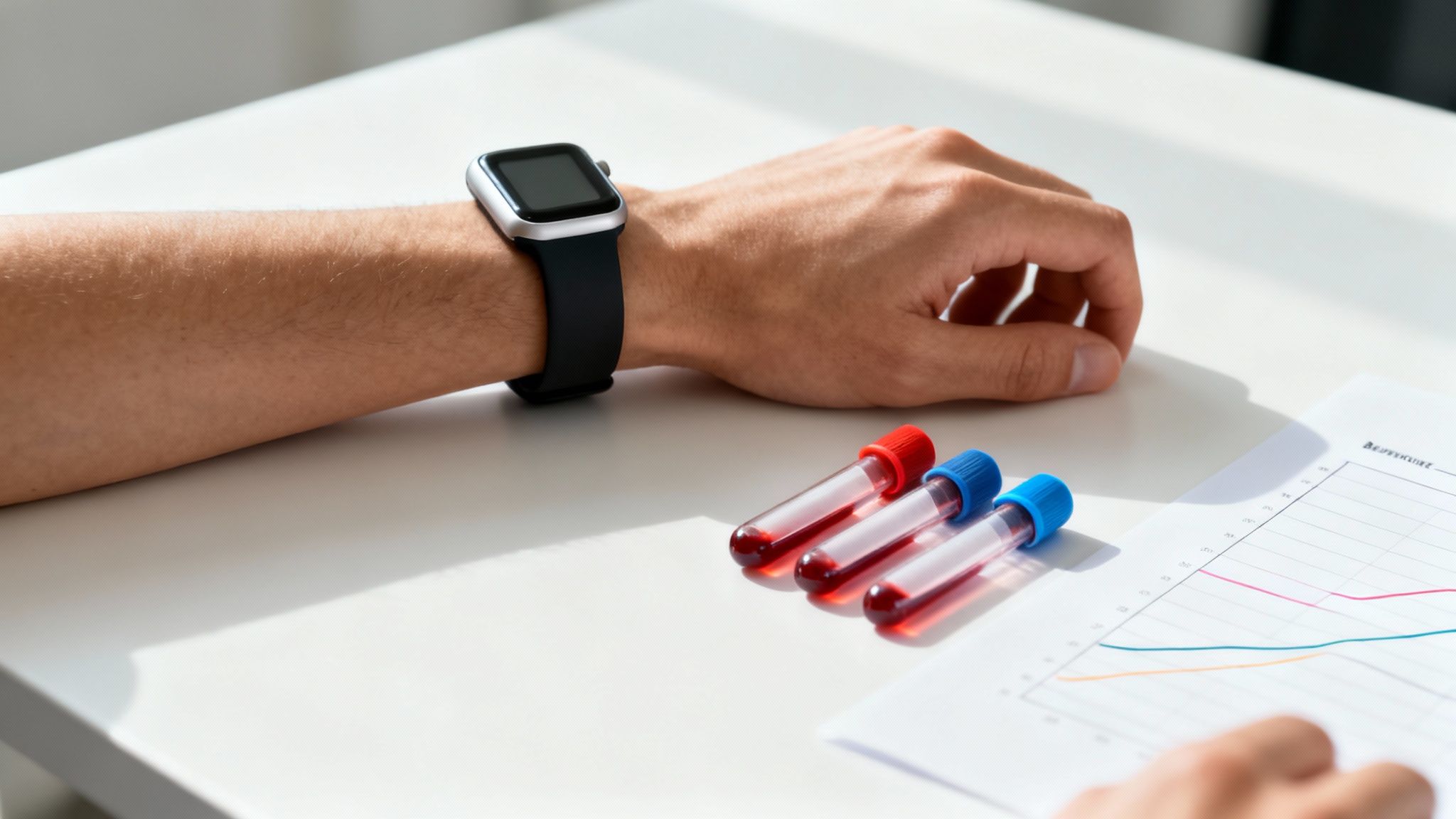
When we talk about retirement readiness, the conversation almost always lands on finances. But what good is a healthy 401(k) if your body isn't ready to enjoy it? The best age to retire isn't just a number on a calendar; it's the point where your finances are secure and your biology is set up for decades of vitality.
Think of it like this: your body has its own internal dashboard, constantly showing you real-time data. The gauges on this dashboard are your key biomarkers—objective metrics that tell the true story of your long-term health potential.
What Your Health Data Is Trying to Tell You
Paying attention to these numbers is the first step toward taking real control over your healthspan. They give you a direct look at how your body is actually aging on the inside, far beyond what you see in the mirror.
Here are a few of the most critical metrics:
Inflammatory Markers: These are your body's alarm signals. High-sensitivity C-reactive protein (hs-CRP), for instance, can point to the kind of chronic, low-grade inflammation that silently speeds up the aging process.
Metabolic Health Indicators: Numbers like fasting glucose, insulin, and your lipid panel reveal how well your body manages energy. Poor metabolic health is a major roadblock to a long, active life.
Hormone Levels: Hormones such as testosterone and estradiol are fundamental to maintaining muscle, bone density, and your overall sense of get-up-and-go.
Learning which longevity markers to track through a comprehensive blood test for longevity gives you the clarity to build a retirement timeline that truly works for you.
Using Your Own Data to Map Out Retirement
We're living in an incredible time where technology gives us a real-time, inside look at our own health. This completely changes the game when it comes to figuring out the best age to retire. Forget generic advice based on population averages—you can now use your own biological data to build a retirement timeline that’s actually built for you.
From my own experience, I can tell you that keeping an eye on my health data has been a revelation. I started noticing small but persistent dips in my sleep quality and daily energy levels. Because I caught these trends early, I was able to make adjustments long before they could have spiraled into bigger issues that might have derailed my long-term plans.
From Numbers to Actionable Insights
The real magic happens when you bring information together from a few different sources to see the whole picture. This isn't about getting bogged down in every little metric. It's about spotting the meaningful patterns that can guide what you do every day.
A smart, data-informed approach focuses on a few key areas:
Sleep Quality: How much deep and REM sleep are you getting? This tells you if your body and brain are actually recharging overnight.
Energy and Recovery: Metrics like Heart Rate Variability (HRV) are fantastic for seeing how ready you are to handle the day's physical and mental demands.
Metabolic Health: Watching your glucose variability shows you exactly how different foods affect your energy and long-term health prospects.
When you start using insights from the best wearables for longevity, you gain the ability to directly influence your healthspan. This gives you so much more freedom and control over when—and how—you decide to retire.
Three Data-Driven Retirement Scenarios
Let's make this real. How does combining financial planning with your personal health data actually change the retirement equation? We can see the trade-offs between wealth and health play out in three common scenarios.
The Early but Unprepared Retiree
Meet the person who did everything right—financially. They built a strong portfolio and hit their magic number in their late 50s. Freedom at last, right?
Not quite. Decades of high-stress work and putting health on the back burner have taken their toll. Their biomarkers tell the real story: elevated inflammation, insulin resistance, and a steady decline in key hormones. They may have retired early, but they're walking into a future where their newfound time and money could be spent managing chronic health problems, not enjoying the life they worked so hard to build.
The Traditional but Drifting Retiree
This is the classic path. Retirement hits around age 65 with a decent nest egg and a solid-enough plan. The problem? They've passively accepted the narrative that getting older means getting weaker and sicker. It's just what happens.
Their lab results show early warning signs of health risks they aren't even aware of, let alone addressing. This creates a dangerous gap where their healthspan—the years of healthy, active living—is unlikely to match their full lifespan. A little proactive health management in those final working years could have completely changed the quality of their retirement.
A great financial plan involves more than just savings; understanding concepts like an asset allocation chart by age is key to making your money work for you.
This is where your personal health data becomes a powerful tool, turning raw numbers from lab tests and wearables into a clear roadmap for your well-being.
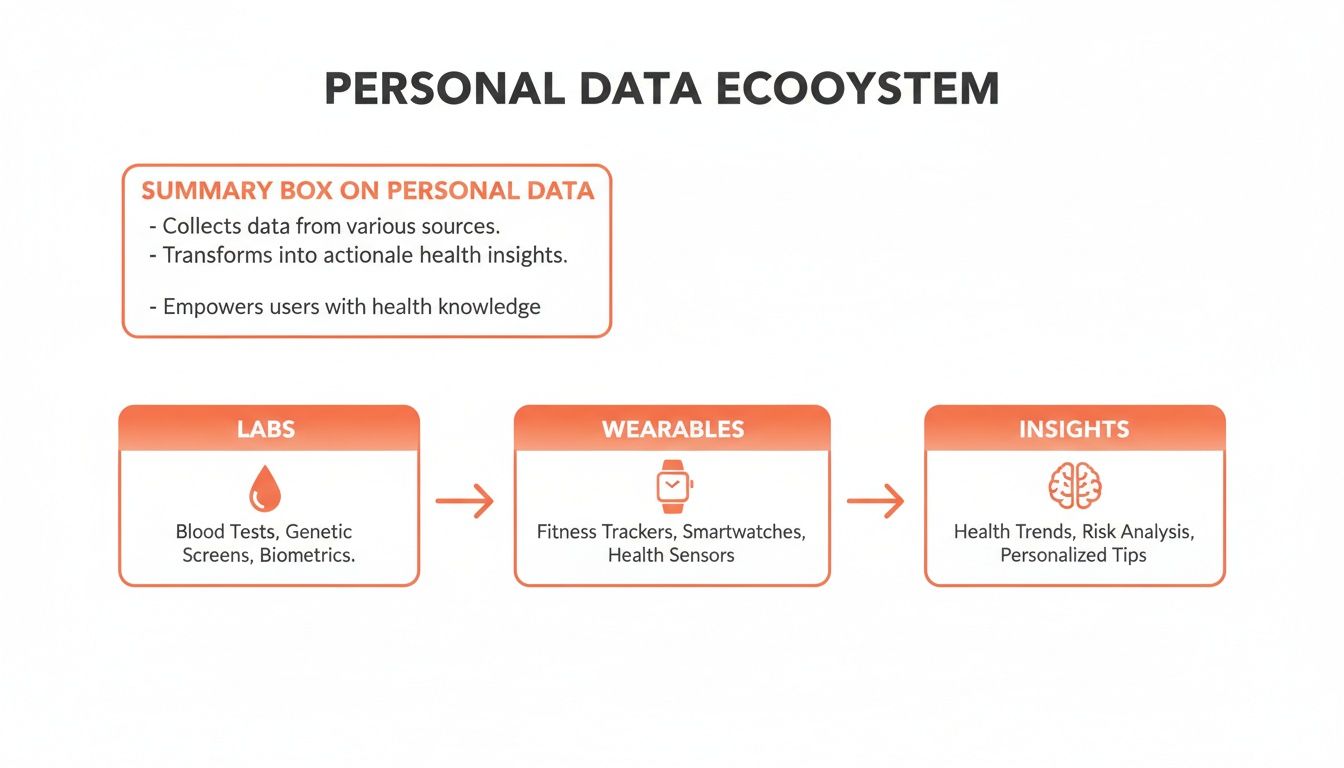
By weaving these data streams together, you can design a retirement strategy that optimizes for both financial security and genuine vitality.
The Optimized and Ready Retiree
Now, this is the goal. This person sees their final decade of work as a dual-track mission: maximize savings and systematically upgrade their health.
They don't guess. They use biomarker and wearable data to see what’s really going on inside their body, fine-tuning their diet, exercise, and recovery strategies based on objective feedback. When they finally step away from their career, they aren’t just financially secure—they’re at their biological peak, ready to launch into a vibrant, active, and deeply fulfilling new chapter.
Your Action Plan for a Healthier Retirement
All this information is interesting, but what really matters is turning insight into action. This is where you move from theory to reality, building a tangible plan that puts you in the driver’s seat of your long-term vitality.
Taking charge of your healthspan isn't complicated. It just requires a few deliberate, common-sense steps. The whole idea is to make sure you’re not just financially prepared for retirement, but also biologically ready to enjoy it.
Your Health-First Retirement Checklist
The journey starts by getting a clear, honest picture of where you stand right now. You can't improve what you don't measure.
Establish a Health Baseline: The first step is to get comprehensive lab work done with a professional. This gives you hard data on your metabolic health, inflammation levels, and hormone balance—your starting line. Everything you do from here on out can be measured against this initial snapshot.
Integrate Wearable Data: Put that smartwatch or fitness tracker to good use. The daily trends in your sleep, activity, and recovery offer a real-time feedback loop. This is your key to making small, consistent lifestyle tweaks that compound into massive improvements over time.
Set Clear Health Goals: You have financial goals for retirement, right? It's time to set health goals with the same seriousness. Make them specific and measurable. For example, you might aim to lower a key inflammatory marker by 10% in the next six months or add 30 minutes of deep sleep to your nightly average.
Consult with Specialists: Find professionals who are focused on proactive, preventative, and data-driven care. A reactive approach to health simply won’t cut it when your goal is to extend your healthspan.
For a deeper dive into the science of vitality, our guide on how to potentially reverse biological aging offers some powerful strategies.
At Outlive Biology, our entire focus is on turning your personal health data into a clear roadmap for a longer, more vibrant life. We combine continuous monitoring, in-depth lab testing, and expert clinical guidance to help you build a retirement defined by your vitality, not just your bank account. Take control of your healthspan today.
Live better for longer.
Research-backed tools, tactics, and techniques to maximize your health, delivered to your inbox every Monday.
Because real transformation starts with trust
and trust starts with clarity.
Founding Member Discount
Includes Devices + Labs
Cancel Anytime Before Activation